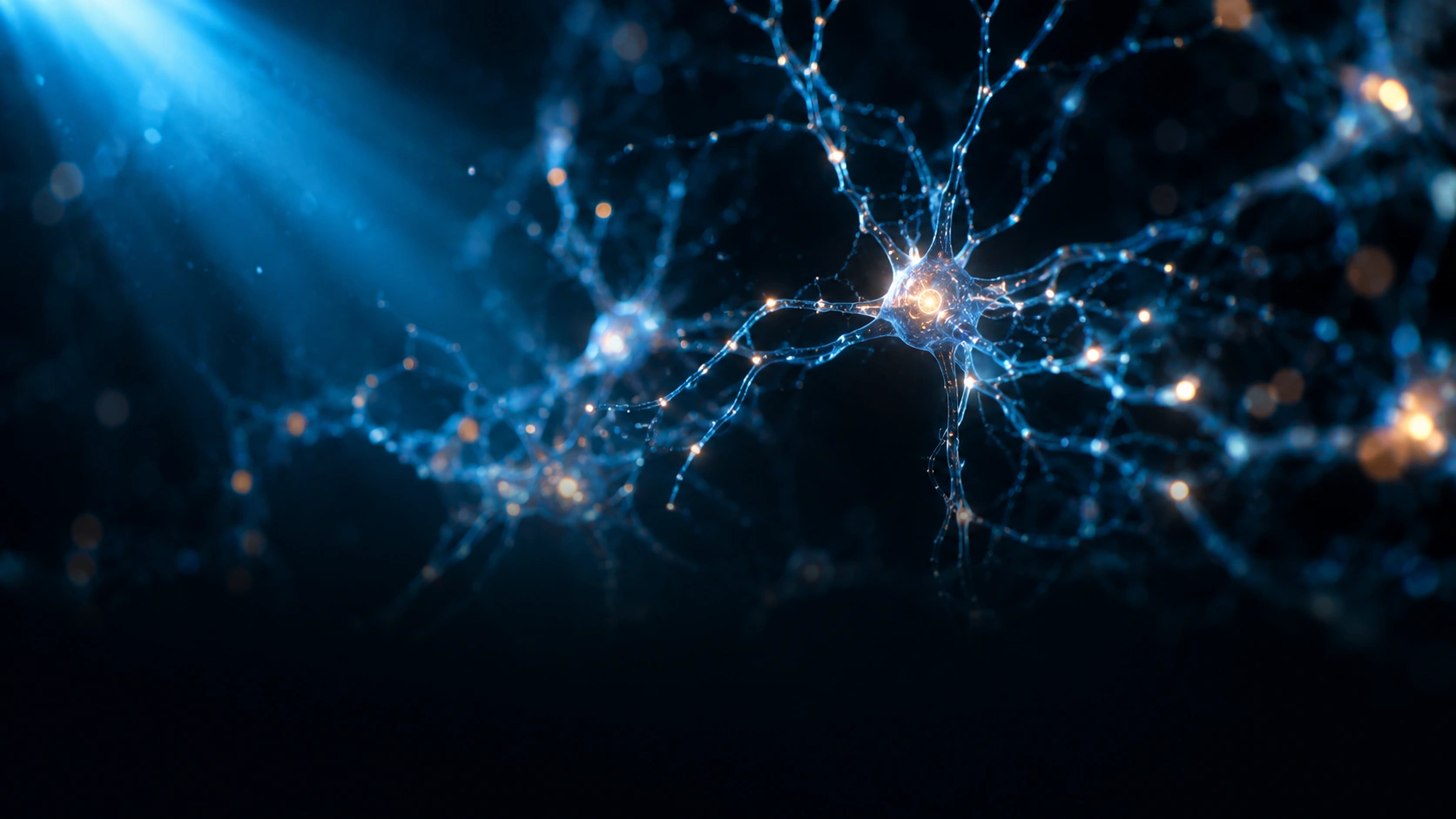
On 5 October 2026 the Nobel Assembly at Karolinska Institutet awarded the Nobel Prize in Physiology or Medicine to Karl Deisseroth of Stanford, Peter Hegemann of Humboldt University of Berlin and Georg Nagel of the University of Würzburg. They won for optogenetics, a method that turns individual nerve cells in a living brain on or off with light.
Why should you care? A lot of what you read about the brain today, from how anxiety works to how a memory gets stored, was tested with this tool. Before it, scientists could see which brain areas lit up during a feeling or an action. They couldn't prove that those cells caused it.
How the switch works
It started with pond algae. In the early 1990s Hegemann wanted to know why the single-celled alga Chlamydomonas swims toward light so fast. Its electrical response came half a millisecond after a flash. He guessed that a single protein both caught the light and opened a channel in the cell membrane. Colleagues were sceptical, since nobody had seen an ion channel that responded to light on its own.
Nagel tested the idea in frog eggs. He put the algal genes into them and got channel proteins that opened under blue light. The second one, channelrhodopsin-2, opened within 0.2 milliseconds. In the human eye, getting from light to an electrical signal takes at least 10 milliseconds, so by our count the algal protein is 50 times quicker. Nagel and Hegemann published channelrhodopsin-2 in 2003.
Deisseroth put the gene into rat neurons, and blue light made them fire. That result came out in 2005. In 2007 his group moved a living mouse's whiskers by shining light onto its motor cortex through a thin optical fibre. Labs later used the same trick to wake sleeping mice and to switch on one specific fear memory.
What it means for patients
So far, not much, and the hype should stay in check. In 2021 Nature Medicine reported a single case. A blind man with retinitis pigmentosa had a gene for a light-sensitive protein, related to channelrhodopsin, injected into one eye. Wearing goggles that turn the scene into light pulses, he could find, count and touch objects on a table. He couldn't see them before the injection, or afterwards without the goggles. It was the first reported partial recovery of function after optogenetic therapy. It isn't an approved treatment, and trials are still running.
The Nobel Committee says the method has already improved scientists' understanding of depression, anxiety, schizophrenia, Alzheimer's and Parkinson's. Cochlear implants are another hope: light might stimulate the hearing nerve more precisely than electric current does.
Who didn't make the list
Edward Boyden was first author on the 2005 paper, and biophysicist Ernst Bamberg co-wrote both the 2003 and 2005 studies. Neither shares the prize. Nobel Foundation rules cap a single prize at three people, and nomination records stay sealed for 50 years, so there's no official word on why the committee picked these three.
The prize is 12 million Swedish kronor, split equally. If you want to see how the brain fools itself without any light at all, read our piece on why your brain creates illusions, or browse our brain and emotions collection.
Sources: Nobel Assembly press release, Nobel Committee popular science background, Sahel et al., Nature Medicine, 2021.