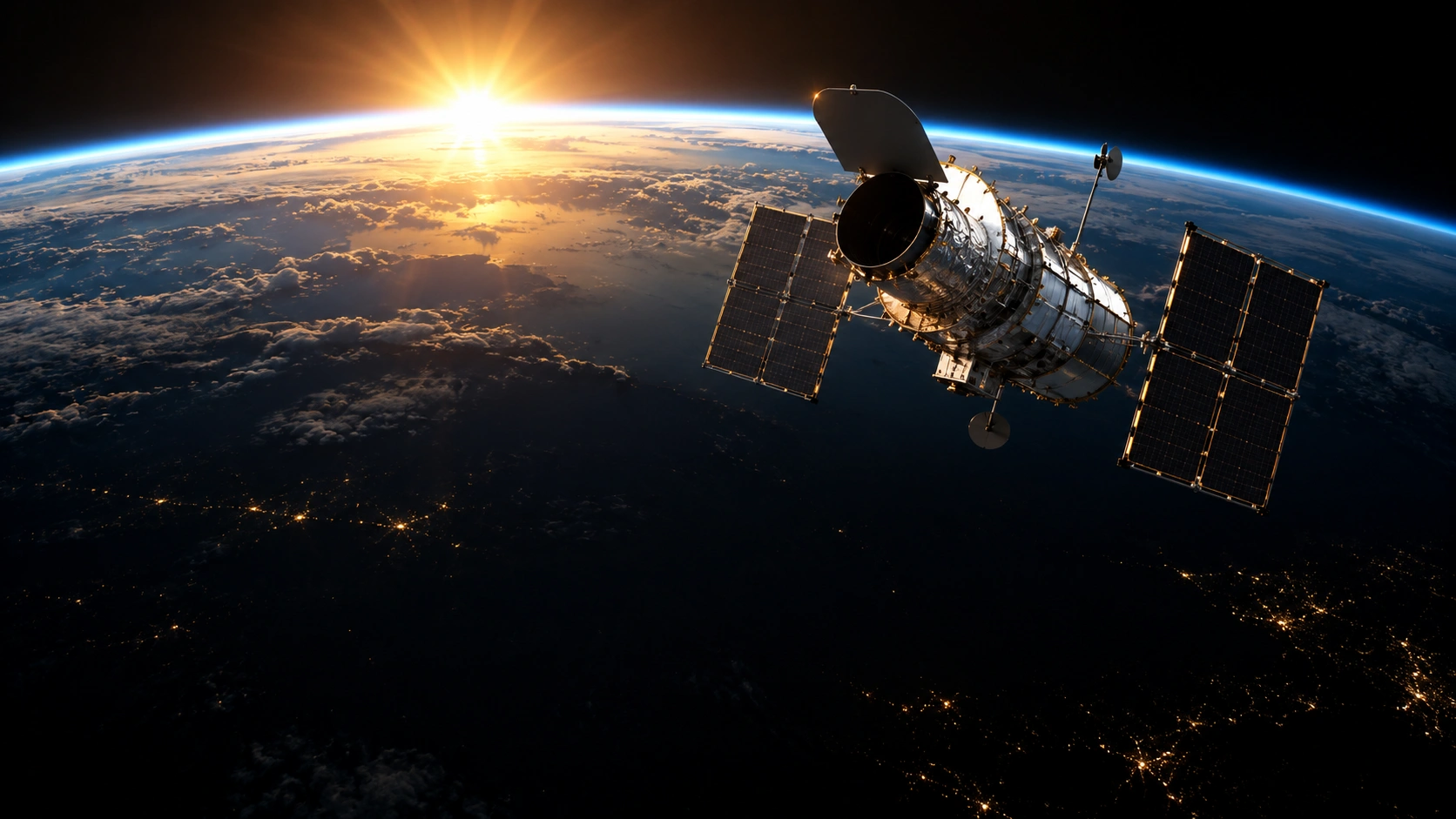
NASA's Swift space telescope, which spent 20 years tracking the most powerful explosions in the universe, is coming down and will burn up in the atmosphere. A $30 million commercial rescue mission failed. The Associated Press expects reentry in early November 2026; NASA says it will happen by the end of the year.
Why the telescope is falling
Swift launched in November 2004 into an orbit about 600 km (373 miles) up. Any satellite at that height slowly drags against the thin upper edge of the atmosphere and sinks. Usually that's slow. But the Sun has been unusually active lately: its outbursts heat and puff up the atmosphere, and drag gets stronger.
Think of a cyclist coasting downhill. With a light breeze, they roll for a long time. With a strong headwind, they stop much sooner. For Swift, that headwind was the Sun.
By August 2026 the telescope had dropped to about 345 km (214 miles). Earlier in the year NASA switched off its science instruments to slow the fall. Swift is now nearing about 300 km (185 miles), described as the point of no return.
How NASA tried to save it
In September 2025, NASA hired Katalyst Space Technologies, a private company in Arizona. The plan was bold: send a "tow" spacecraft called LINK to grab Swift and push it back up to about 600 km.
- July 3, 2026: LINK launched successfully.
- A few weeks later, hardware glitches sent it spinning and hard to control.
- August 20: NASA and Katalyst called off the capture.
- September 25: LINK itself fell back to Earth.
"From the beginning, this was a high-risk, high-reward mission," said Shawn Domagal-Goldman, director of NASA's Astrophysics Division. NASA Administrator Jared Isaacman said, as paraphrased by Phys.org, that the outcome wasn't what the team wanted but the attempt was worth making.
Is it dangerous for people?
Hardly. According to the European Space Agency (ESA), no one is known to have been injured by falling space debris, and being struck by lightning is 60,000 times more likely. About 75% of Earth is covered by water, and much of the land is uninhabited.
ESA does note that 20-40% of a large satellite's mass can survive an uncontrolled reentry. The exact time and place usually become clear only in the final days.
What science loses
Swift could swing toward a new flash in the sky within minutes and alert other telescopes. It studied gamma-ray bursts (the most powerful explosions in the universe, releasing more energy in seconds than the Sun will in its lifetime), exploding stars and black hole flares, and even measured water on the interstellar comet Borisov.
The same threat hangs over the famous Hubble telescope: at 36, it's also losing altitude due to solar activity. It was meant to be next in line for a rescue.
Editor's view: one failure doesn't make the idea pointless. This was the first attempt by a private company to boost someone else's science satellite, and Katalyst is still testing LINK near Swift. If the technology matures, future telescopes, Hubble included, could be saved instead of lost.