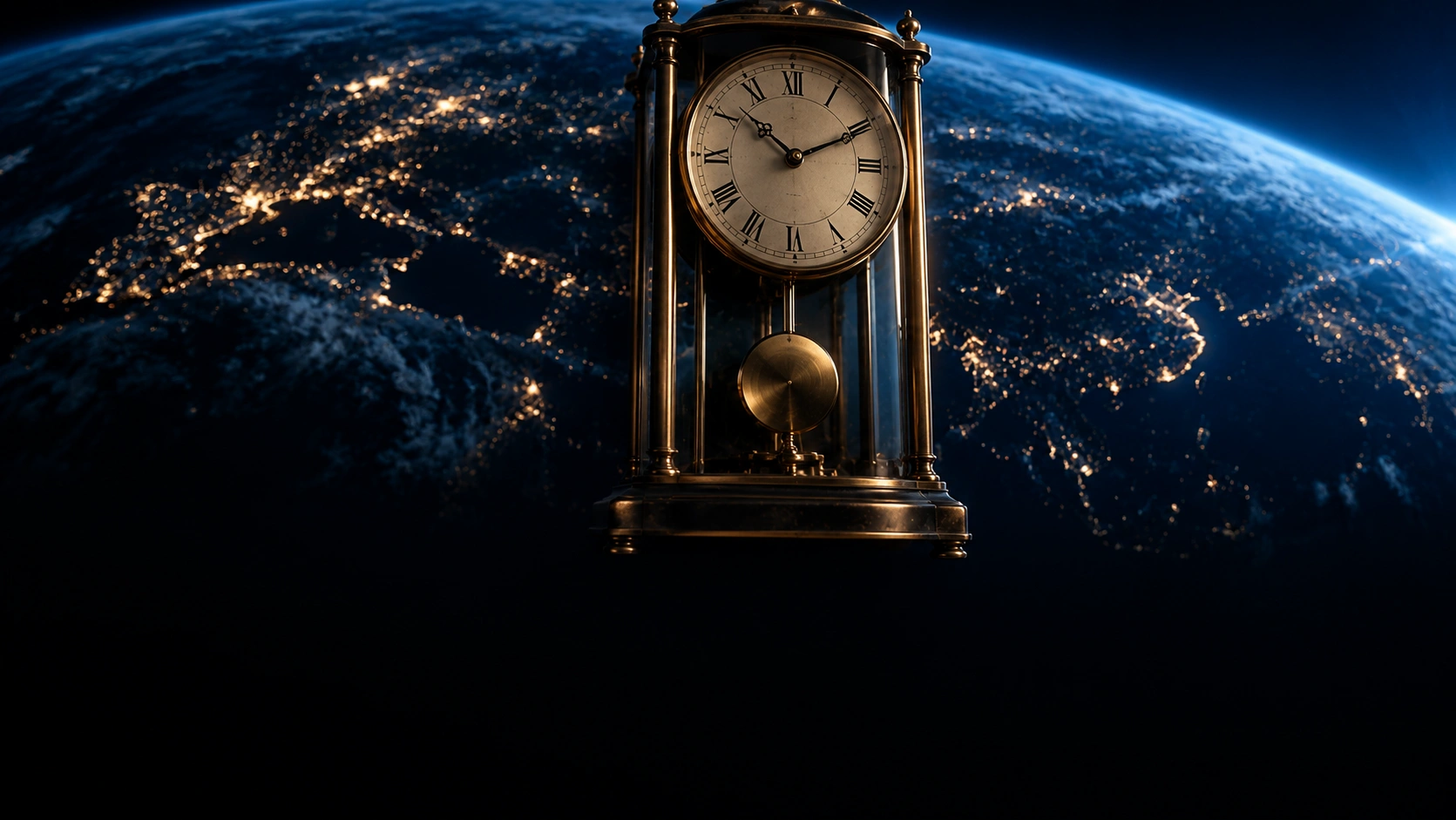
On October 15, 2026, the General Conference on Weights and Measures voted in Versailles to scrap the leap second. From May 20, 2027, Coordinated Universal Time (UTC, the time standard every clock on earth follows) will run without extra seconds. Your phone and watch won't notice. Programmers will sleep better.
What a leap second is and why we had it
Humanity keeps two clocks. One is atomic: it counts seconds by the vibrations of atoms and barely ever drifts. The other is the Earth itself: a day is one full spin. The problem is that the planet doesn't spin evenly. Tides slow it down, and melting ice and earthquakes nudge its speed.
To keep atomic time in step with the sun, an extra second was added to the world's clocks 27 times since 1972, most recently on the night of December 31, 2016. For one moment clocks read 23:59:60, a time that doesn't exist on a normal day.
Why it had to go
That extra second broke software. Programs assume a minute has 60 seconds, and after the July 2012 leap second, Reddit, Mozilla and many Linux-based sites ran into trouble. Google ended up "smearing" the second, spreading it over 20 hours in tiny slices so its servers wouldn't notice.
The bigger worry came later. Since around the mid-2010s, Earth has been spinning slightly faster. The shortest day ever measured was June 29, 2022, at 1.59 milliseconds under 24 hours. Scientists began talking about the first-ever negative leap second, removing a second instead of adding one. Nobody has done that before, and nobody knows how banks, navigation and telecom systems would cope. Engineers called it a mini Y2K.
"Avoiding negative leap seconds is a very big driver," Nick Stamatakos, head of the Earth Orientation Department at the U.S. Naval Observatory, told Scientific American.
What replaces it
Atomic time and sun time will now drift apart, but slowly. The new rules allow a gap of up to one hour, and fixing it shouldn't be needed for at least 1,000 years. How to do that is left to future generations.
Put in plain numbers: 27 seconds built up over 54 years, about half a second a year. Reaching a full hour takes millennia, and noon won't visibly shift on your watch in the meantime.
What it means for you
- Phone and computer clocks keep working as before. They already sync with time servers automatically.
- Daylight saving time is not affected. Governments decide that, not timekeepers. We covered how to get through the next clock change without wrecking your sleep in a separate guide.
- Astronomers lose a convenient shortcut: UTC will no longer closely track Earth's rotation, so they will need separate data for it.
The debate lasted 30 years. In 2022 the conference agreed to end leap seconds "by 2035". In 2026 it set the date.