For informational purposes only. This article does not replace professional medical advice and is not intended for self-diagnosis or self-treatment. Consult a qualified healthcare provider before making health-related decisions.
Clocks in Europe and the UK go back one hour overnight into Sunday, October 25, 2026. The US and Canada follow a week later, on November 1. The autumn change gives you an extra hour and is easier than the spring one, and studies haven't found a raised heart risk after it. It can still throw off your routine, but you can adjust in 3-4 days: shift your sleep by 15-20 minutes a day and get morning light.
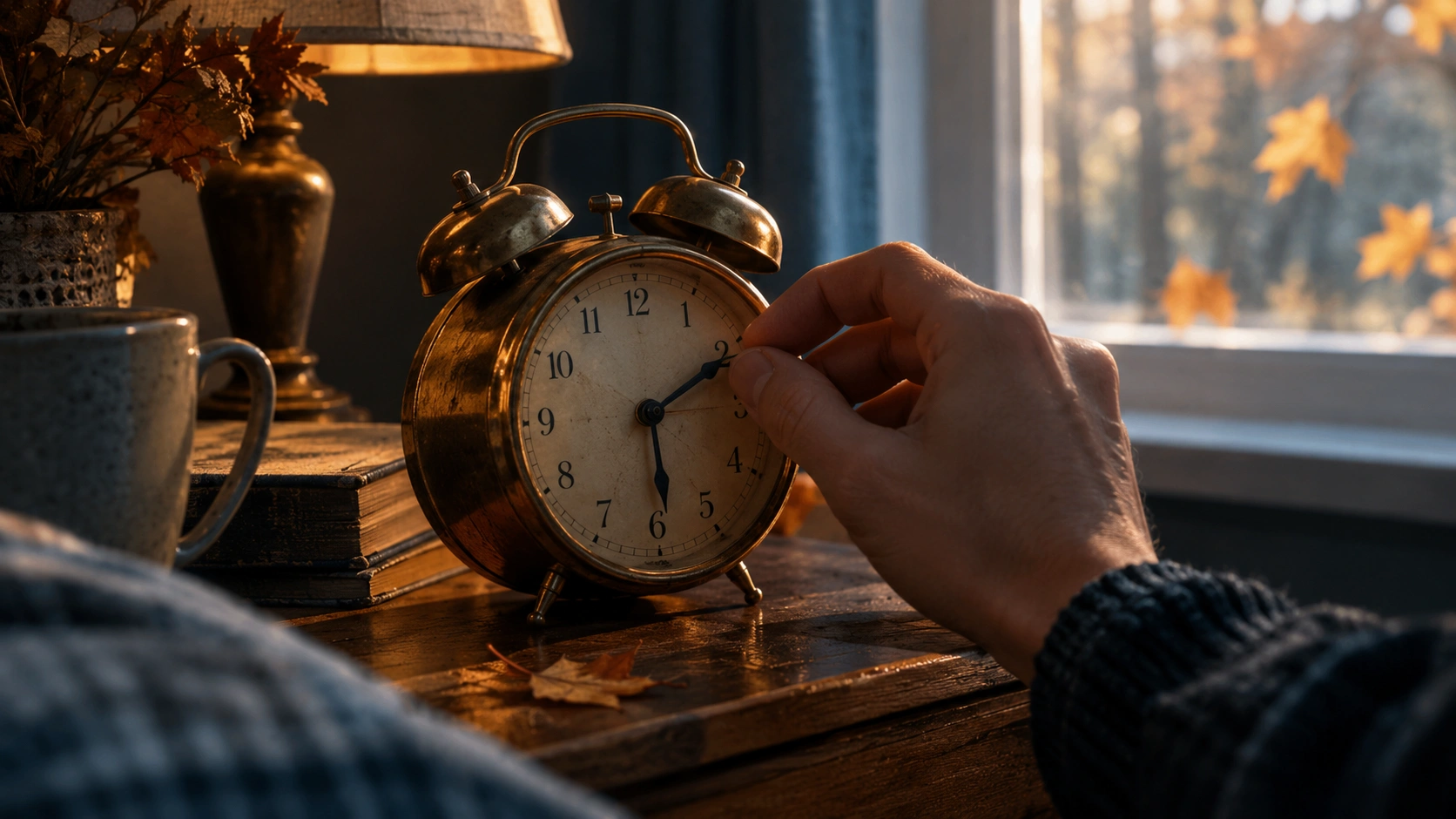
Sunday, 8 a.m. Your phone already says 7, but the oven clock insists it's 8. You slept well, yet by evening it gets dark so early that you want to crawl into bed at 6. By Wednesday you're waking before the alarm and snapping at everyone by lunch. All of it comes from the same hour: taken in spring, handed back in autumn.
When do the clocks go back in 2026?
October 25 in Europe and the UK, November 1 in the US and Canada. Country by country:
- European Union: October 25, everywhere at once, at 01:00 UTC (in Berlin and Paris, 3:00 a.m. becomes 2:00 a.m.).
- United Kingdom: October 25, at 2 a.m., returning to Greenwich Mean Time. British Summer Time comes back on March 28, 2027.
- US and Canada: November 1, at 2 a.m. local time. Hawaii and most of Arizona don't change their clocks at all.
- Kazakhstan: no seasonal change, and since March 1, 2024 the whole country runs on one time zone, UTC+5.
One detail for anyone with calls across the Atlantic. From October 25 to November 1, London and New York are four hours apart instead of five. That's the week when meetings get missed.
Why is falling back easier than springing forward?
Because in autumn the clock returns to a time that sits closer to your body's own clock. Spring takes an hour of sleep away. Autumn gives it back.
To see why that matters, you need one fact about your circadian rhythm (the internal body clock that decides when you feel sleepy and when you wake up). Light is what sets it. The American Academy of Sleep Medicine (AASM), a US association of sleep doctors, explains it in its 2024 position statement: morning light pulls your internal clock earlier, evening light pushes it later. Daylight saving time adds bright evenings and takes away bright mornings, so all summer it drags your rhythm later than your alarm clock wants.
Think of a train that ran an hour late all summer. In autumn the timetable finally matches how the train actually runs. It's easier on the train, but passengers still get confused for a few days.
Is the clock change really bad for your heart?
For the spring change there's evidence. For the autumn one there isn't. People often lump both together, but the research tells two different stories.
In 2019, Italian researchers led by Roberto Manfredini pooled seven studies covering more than 115,000 people and looked at heart attacks in the two weeks after a clock change. What they found:
- after the spring change, heart attack risk rose by about 5%;
- after the autumn change, it was no different from ordinary weeks.
An important caveat. All seven were observational studies (researchers saw a link but couldn't prove the clock change caused it), and the authors themselves call for more research. Also, 5% is an increase on a very small number. It doesn't mean a 1-in-20 chance for each person.
So the autumn change is harmless? Not quite. The problem just lives somewhere else.
What actually goes wrong after the clocks change?
Your routine and your mood, not your heart. The Sleep Foundation, a US sleep research nonprofit, notes that after the autumn change your sleep schedule can stay off for a week or longer. It usually looks like this:
- early waking: your body still runs on the old time and wakes you an hour before the alarm;
- evening sleepiness: it gets dark an hour earlier, and tiredness hits by 6 or 7 p.m.;
- kids and pets: nobody told them the clocks changed, so they want breakfast on the old schedule;
- the long tail: the AASM links social jet lag (the gap between your body clock and your work or school schedule) to obesity, heart disease and depression, with teenagers and night owls hit hardest.
The good news is that a simple plan over a few days handles most of it.
How do you adjust to the time change in 3-4 days?
Shift your schedule gradually and manage your light. Step by step:
- 3-4 days before the change, go to bed and get up 15-20 minutes later each day. By Sunday you'll be almost on the new time.
- On the night of the change, go to bed as usual, then get up by the new time, not by how you feel. Use the extra hour to sleep, not to lie in bed scrolling.
- Get light in the morning: open the curtains right after you wake up and get outside for at least 10-15 minutes. Nothing resets your body clock faster.
- Dim lights and screens in the evening, an hour before bed. We explained why feeds are hardest to put down at night in Why You Can't Stop Scrolling.
- Keep coffee before noon for the first few days. Same goes for energy drinks, and our piece on what energy drinks do to your body covers their effect on sleep.
- Shift kids and pets the same way, 15 minutes a day: breakfast, walks and bedtime a little later than yesterday.
If two weeks later you still wake up exhausted and struggle to fall asleep, the clock change is no longer the reason, and it's worth talking to a doctor.
Why do we still change the clocks at all?
Because countries can't agree which time to keep for good. The European Union is a clear example:
- in 2018, the European Commission proposed ending seasonal clock changes;
- in March 2019, the European Parliament voted in favor;
- since late 2019, the plan has been stuck in the Council of the EU, where member states can't agree whether to stay on summer or winter time;
- in 2026, the Commission launched a new assessment of the effects on transport, energy and health, due by the end of the year.
Sleep doctors have already picked a side. Since 2020 the AASM has called for ending clock changes and keeping permanent standard (winter) time, which matches human biology better. Daylight saving time, they point out, shifts your rhythm later and builds up sleep debt for months, and in the US fatal car crashes rise by up to 6% in the week after the spring change.
What to do today
Walk around your home and list every clock that won't update itself: oven, microwave, car, wall clock, wristwatch, that old alarm clock. It takes two minutes. On Sunday morning you'll fix them all in five, and your oven will stop arguing with your phone about what time it is.
Sources
- AASM: Permanent standard time is the optimal choice for health and safety (JCSM, 2024)
- Manfredini R. et al. Daylight Saving Time and Acute Myocardial Infarction: A Meta-Analysis (J Clin Med, 2019)
- NIST: Daylight Saving Time in the US
- Time Out London: when the clocks go back in 2026
- LRT: why Europe still hasn't ended clock changes (2026)
- timeanddate: ending clock changes in the EU
- Kazakhstan Ministry of Trade and Integration: single time zone