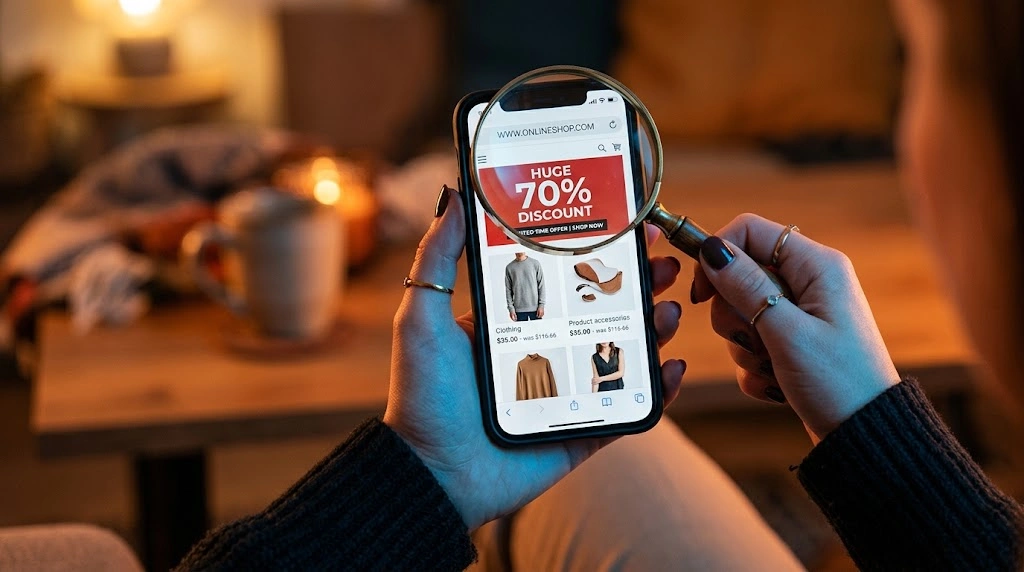
It is evening, a 60% discount on the exact jacket you wanted, the site looks neat, payment takes one tap. Three days later there is no parcel and nobody answers in the shop chat. That is not buyer carelessness: a fake shop is built in an evening from a template, stolen photos and a tempting price. But such a site almost always leaves small details that give it away.
How to tell a scam website
Six signs give a scam site away most often: a young domain (the site address, registered recently), no seller details, no live contacts, a price far below the market, payment only by transfer and reviews only on the site itself. One sign is not a verdict, three or more is a reason not to pay. The fastest way to see them together is the free Awe Check trust check: it collects the technical signs itself and gives a score from 0 to 100.
1. The shop's domain is very young
A domain is the site's address, like a street for a shop. It is registered for a period, and a real business usually pays for it well ahead and has had it for a while. A fake gets opened and closed quickly, so its domain may be a few days old and paid for only briefly. The WHOIS service (a public record of who registered an address and when) shows the registration date and expiry, and so does our trust check.
Compare the address with the real one too. Fakes copy a familiar name with an extra letter, a hyphen or a different zone (.shop instead of .com). If you came from an ad, open the shop through a search and compare the addresses.
2. There are no seller details
A real shop lists a legal entity or sole trader, a registration number and an address in the footer or terms. You can check the number in your country's official register: the company must exist and carry the same name as on the site. If details are missing or lead to an unrelated business, do not pay.
3. Contacts do not answer
A contact form and a messenger with no phone and no email on the shop's own domain is a warning sign. Write or call before paying: an honest seller answers within a reasonable time, a fake stays silent or rushes you. Pressure is one of the four main signs of a scam in the description by the US Federal Trade Commission (FTC): scammers do not give you time to think.
4. The price and payment method look odd
A 50-70% discount on a popular item and a request to pay by transfer to a person's card rather than the bank's payment page almost always mean fraud. FTC advises never paying someone who insists you can only pay one way: cryptocurrency, a money transfer service, a payment app, a gift card or a cheque. Card payment through the bank's page protects better because the payment is easier to dispute.
5. Reviews exist only on the site
Reviews a shop posts on its own pages prove nothing: the seller writes them. Search the shop's name and address together with words like "reviews" and "scam". If a shop has no mentions anywhere, that is a signal too: real sellers sooner or later leave traces.
6. The padlock does not guarantee honesty
The padlock means one thing: the connection between you and the site is encrypted. The certificate (the digital document that provides this) is available to any site today, including for free: the Let's Encrypt authority describes itself as free and automated. That is why scammers have the padlock too. Its absence on a page that asks for card details is a red flag.
Why fakes look so convincing
The reason is the economics of fraud. A shop template is cheap, photos are taken from real sellers and the reviews are written by the owners. A site lives for a few weeks while ads bring traffic and disappears when complaints pile up. A new address goes up in a day, so a neat design says nothing about the seller. Trust what is hard to fake quickly: domain age, details you can verify in a register and mentions of the shop outside its own site.
There is a psychological part too. The scheme runs on haste: only two left, a discount until the end of the day. It is exactly the pressure sign FTC describes. When you are being rushed, stop and go through the list above: five minutes of checking is cheaper than the lost amount.
An example of how it works
Imagine a watch shop with a 65% discount. You look at the domain: it was registered two weeks ago for one year. There are no seller details in the footer, the chat replies with a template only, and payment is offered by transfer to a private card. Three of the six signs match, so it is better to walk away. If a shop has details, a live phone, a domain older than a couple of years and reviews on an independent platform, the risk is noticeably lower, although nobody can give an absolute guarantee.
How to check a site in a minute
- Open the website scam check.
- Paste the shop address and press Check trust.
- In a minute you see the trust score and the signs behind it: secure connection, certificate and domain expiry, privacy policy, contacts and seller details.
The score is not a guarantee of a seller's honesty: a fraudster can buy a certificate and design a nice site. But a low score almost always means you should not pay there. If you run a shop yourself, read how to find silent customer leaks on your own site.
What to do if you have already paid
Act within the first hour: money comes back only when you act fast. If you paid by card, call the bank using the number on the back and ask to dispute the payment. If it was a transfer or a payment app, write to the bank or service and ask them to reverse it. Cryptocurrency is hardest to recover, but contact the exchange at once too. Then keep the messages, receipt and the site address and report it to the police or the right agency in your country. In the US the place is ReportFraud.ftc.gov.
Tonight, pick one suspicious shop from your purchase history and see how it looks in a trust score.
Sources
- FTC: How to Avoid a Scam - four signs of a scam and payment methods scammers demand.
- FTC: What To Do if You Were Scammed - steps by payment method and where to report.
- Let's Encrypt - a free, automated certificate authority.