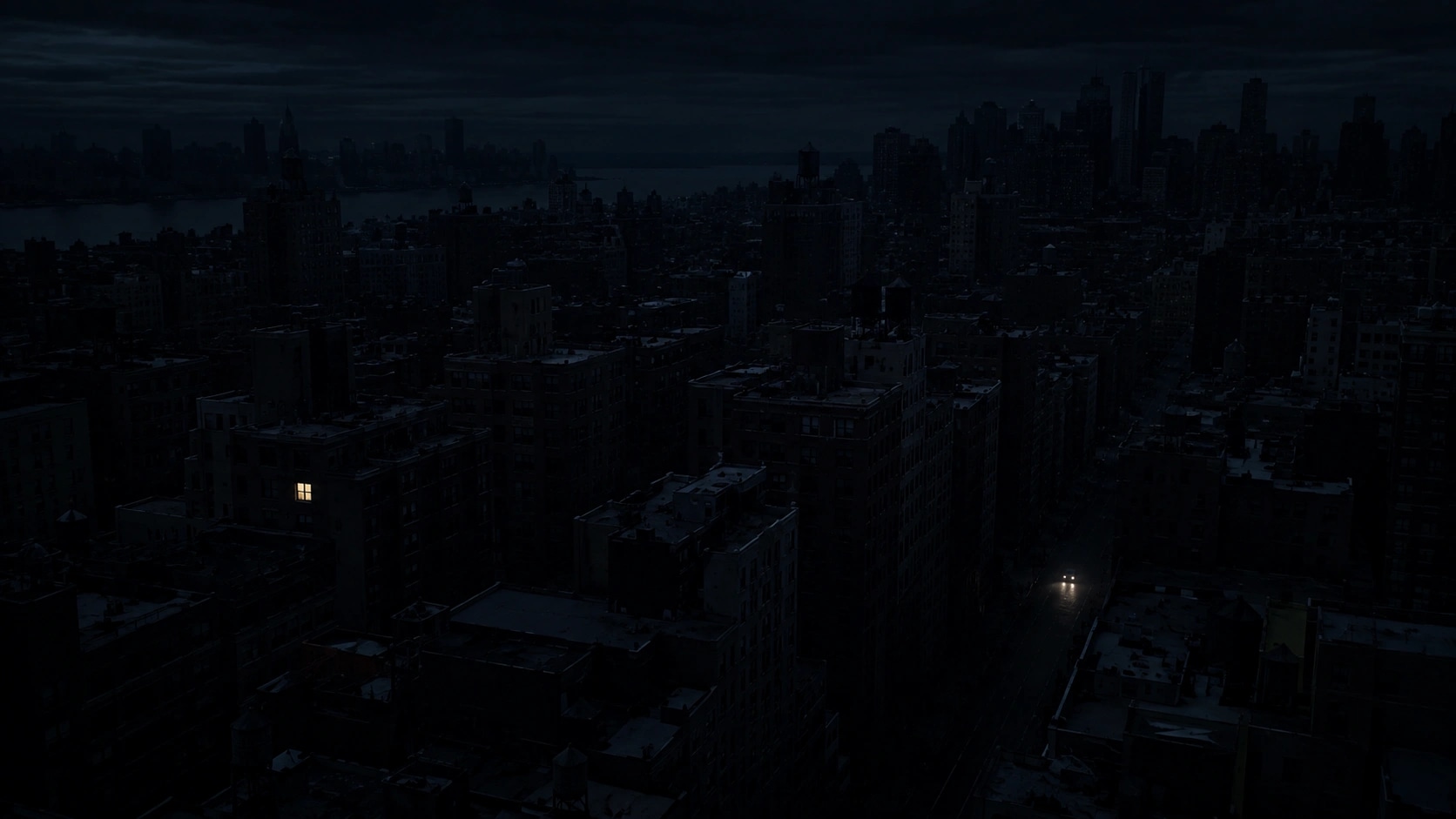
On 28 April 2025, at 12:33 in the afternoon, the lights went out across mainland Spain and Portugal. Not in one city. In two countries at once. Portugal was fully back after nearly twelve hours. Spain took about fifteen and a half.
Sixteen months later, on 14 August 2026, two hydro generators tripped at a single dam in Kyrgyzstan. Within a minute, parts of four countries went dark.
The lights go out for millions at once because a power grid is not a bundle of separate wires. It is one enormous machine whose parts all spin in step. Break one part, and the whole machine slows down - not just the corner where the fault happened. Here is how that actually works, why the power cannot be switched back on with one button, and what it means for your own home.
Electricity cannot be stored: it is made the second you switch on the kettle
The grid stores no electricity at all. The current lighting your room right now was generated a fraction of a second ago, and it is gone the instant you use it.
This is what makes electricity unlike almost everything else you rely on. Water sits in a tower. Gas sits in storage. Food waits in the fridge. Electricity is produced in the same second you ask for it, in exactly the amount you ask for.
Engineers call this a just-in-time system (goods made at the moment they are needed, with no warehouse in between). Every unit of power you consume, somebody generated at that same instant.
From this comes the rule that everything else in this article grows out of: whatever goes into the grid must come out of it, continuously. Not roughly. Not averaged over an hour. At every moment.
Batteries do not change this. Every battery on Earth put together holds a tiny fraction of what humanity uses in a single day. For one house, a battery solves the problem. For a country, it does not.
Which raises a fair question. How do you track that balance in real time, when kettles across a whole country switch on and off millions of times a minute? The answer turned out to be surprisingly elegant.
What 50 hertz really means: the speed of one shared carousel
Grid frequency - 50 hertz in most of the world, 60 in North America - is the speed at which every generator in the system spins together. It is not a property of your wall socket. It is the vital sign of the entire network.
Picture a giant carousel. Power stations are the people pushing it. Every kettle, machine and lift switched on across the country is someone hanging off it, slowing it down. As long as pushing and dragging stay equal, the carousel turns at exactly 50 revolutions per second. That is 50 hertz.
Now the part that matters. There is only one carousel. It does not spin faster in the corner with more pushers. If one pusher suddenly lets go, the whole thing starts slowing at once - in his corner and a thousand kilometres away, at the same moment.
In a real grid:
- Generate more than is consumed, and frequency climbs above 50.
- Consume more than is generated, and it drops below.
- A drift of a fraction of a hertz is already an emergency.
This is why grid operators watch one number all day. Frequency is the pulse of the network. Like a human pulse: 60 beats means healthy, 160 means something is badly wrong.
The carousel has one more property that saves the system daily. Generators are multi-tonne pieces of spinning metal, and you cannot stop them instantly. Engineers call this inertia (energy stored in a rotating mass, like a heavy flywheel that keeps turning after you stop pushing it).
When power suddenly vanishes from the grid, inertia buys a few precious seconds: generators spin slightly slower and release their stored rotational energy into the network. Those seconds are usually enough for automatic protection systems to react.
Usually. Here is what happens when they are not.
Why one failed station can darken four countries
Because every station that trips offline makes conditions worse for the ones still running - so they trip too. It is a chain reaction, and it unfolds in seconds.
Step by step, with nothing skipped:
- The first loss. A large generator drops off the network. The cause can be anything: a mechanical fault, a protection device firing, a line coming down.
- Frequency starts falling. Consumption has not changed, but generation has dropped. The carousel slows - everywhere at once.
- The load shifts to neighbours. Current that flowed through the lost station now flows through other lines. They begin to run overloaded.
- Protection fires. Every line and generator has automatic protection that disconnects the equipment when limits are crossed. This is not a design flaw but a necessity: an overheated line sags and snaps, and an unprotected generator burns out and takes years to replace.
- Each disconnection worsens things for the rest. So they disconnect too. And round it goes.
Notice the uncomfortable detail: every individual protection device in that chain worked correctly. Nobody made a mistake. Each one did exactly the job it was installed to do. A sum of correct local decisions produced a catastrophic global outcome.
This is the awkward trade-off built into large grids. Connecting countries together is genuinely useful: when one has a surplus and another a shortfall, they cover each other. But the same connection that carries help also carries failure.
Which brings us to the question anyone who has sat in the dark has asked: so why did my neighbour still have power?
Why your neighbour still had power and you did not
Because automatic systems shed customers by pre-arranged priority lists, not by neighbourhood - and your building can sit in a different queue from the one across the street.
When frequency falls, the operator has one effective move: cut consumption fast so it matches generation again. In plain terms, disconnect some customers to save the rest. Automatic equipment does this without waiting for a human, because there is no time for a human.
The queues are ordered by importance. Hospitals, water utilities and communications go last. Residential blocks go first. And the boundary between queues runs along substations and feeder lines, not along streets. Your building and the one opposite can hang off different lines even if they are twenty metres apart.
A separate case is the flicker: lights blink for a second or two and come back. That is usually not a loose connection. It is most likely automatic reclosing - the line tripped because of a short circuit, perhaps a branch falling across a conductor, and the system waited a fraction of a second and switched it back on. If the fault was temporary, everything carries on. If not, the line stays off.
Then there is the third and most frustrating scenario: the grid is fine, but you are dark because one single component failed somewhere in your chain. On 21 March 2025, one transformer failure shut down London Heathrow airport. Britain's grid was working normally the whole time.
Fine. The lights are out. Why can nobody simply switch them back on?
Black start: why a grid cannot be switched on with one button
Because most power stations cannot start without electricity - and in a total blackout, there is none to borrow.
It sounds like a paradox, but it is literal. A large power station needs energy to begin producing energy: for pumps, fans, control systems, valves. For steam turbines, these internal needs run up to 10% of the station's own output. Normally the station simply takes that from the grid. In a full blackout there is no grid.
Getting out of that trap is called a black start (restarting a station with no external power at all). Engineers describe it as pulling yourself up by your own bootstraps, and it goes like this:
- A diesel generator starts - big enough to power the station's lights and control room.
- That starts a larger generator, usually a gas turbine.
- The gas turbine powers the pumps and valves of the main unit.
- The main unit spins up and begins feeding real power into the network.
- Neighbouring sections are reconnected one at a time - and every reconnection shakes the frequency again.
That last point is why this takes hours rather than minutes. The grid is rebuilt as separate islands, and each time a new block of customers is attached to a working island, the balance has to be held all over again. Reconnect too fast and the whole thing collapses back into darkness.
Add to this that a full blackout is extremely rare, so it cannot genuinely be rehearsed. People work under enormous pressure, with equipment operating outside its normal range.
The Iberian numbers show the scale. Power failed at 12:33. Portugal was fully restored by 00:22 the next day - almost twelve hours. Spain finished around four in the morning, roughly fifteen and a half hours.
And here is where many people get an unwelcome surprise that sellers rarely mention.
Why rooftop solar shuts down along with the grid
Because the inverter is required to disconnect when the grid fails - it is a safety rule, and it acts within two seconds.
People install panels expecting to have power during an outage. Then the outage comes, the sky is clear, the panels are fine, and the sockets are dead. Nothing is broken.
Ordinary panels feed the house through an inverter (a device that converts the panels' output into the kind of current a home uses). A standard home inverter is grid-following: it matches the voltage and frequency it receives from outside. No grid, nothing to match, so it stops.
But the main reason is not technical, it is human. It is called anti-islanding (preventing a dead section of network from being quietly re-energised by a local source). Picture a repair crew working on a downed line they have confirmed is dead - while your panels are feeding voltage into it. For someone up that pole, this is fatal.
So international standards require the inverter to disconnect within two seconds of losing the grid. That is a deliberate feature, not an oversight.
What does give you real independence: a system with a battery and an inverter capable of running in island mode, wired to a separate circuit for critical sockets. That setup isolates the house from the outside network and runs it from the battery. It costs noticeably more than plain panels, and it is worth establishing before you buy, not during a blackout.
What actually broke: five real blackouts
In almost every major blackout of recent years there was no single cause - several factors lined up at once. Here are five cases from five continents, each showing a different face of the same mechanism.
Spain and Portugal, 28 April 2025. The largest blackout in Europe in decades. The final report was produced by a 49-member expert panel drawn from grid operators, regional coordination centres and regulators, and the 440-page document was published on 20 March 2026. Its conclusion: there was no single cause. Oscillations in the network, gaps in voltage and reactive power control, differing voltage regulation practices between operators, and cascading generator disconnections in Spain all combined. The result was a rapid rise in voltage and a chain of stations dropping offline. Worth noting: the report points at voltage control and grid resilience, not at renewable energy as such.
United States, 2024. A wealthy country with a developed grid - and the average customer still spent 11 hours without electricity over the year, nearly double the average of the preceding decade. Three hurricanes caused 80% of those hours: Beryl, Helene and Milton. Helene alone cut power to 5.9 million customers across ten states, Milton to 3.4 million in Florida, Beryl to 2.6 million in Texas. For comparison, outages unrelated to major events run steadily at about two hours a year.
Chile, 25 February 2025. A 2x500 kV high-voltage line between Vallenar and Coquimbo tripped while carrying roughly 1,800 MW. The cause was a malfunction in electronic protection systems and software. Around 98% of the population lost power. The government imposed an overnight curfew; by the following day about 94% of households were back. A telling case: physically nothing burned out, the protection logic failed.
Sub-Saharan Africa. Here the problem is of a different order. According to the International Energy Agency, 730 million people worldwide had no electricity at all in 2024. Around 600 million of them live in sub-Saharan Africa, which is 47% of the population there. Eight out of every ten people on the planet without electricity access live in that region. For hundreds of millions, a blackout is not an emergency, it is an ordinary Tuesday.
Central Asia, 14 August 2026. The most recent and clearest example of a cascade crossing borders. At 14:37, two hydro generators disconnected at the Toktogul hydroelectric plant in Kyrgyzstan. That overloaded the north-east-south transmission corridor of the Kazakh grid, and the southern zone separated from the unified network. Eight regions of Kazakhstan were affected, along with Kyrgyzstan, Uzbekistan and Tajikistan. Traffic lights failed and communications were disrupted.
All five share one thing: the incident began locally, and it was the connectedness of the grid that gave it scale.
Why this will happen more often
Demand on grids is growing faster than the grids themselves, and it comes from three directions at once.
First, heat. Air conditioners switch on for millions of people simultaneously during the hottest hours, exactly when the equipment itself is already strained by temperature. The Iraqi outage on 11 August 2025 happened during extreme heat.
Second, data centres. The server halls behind cloud services and artificial intelligence consumed roughly 415 terawatt-hours in 2024, about 1.5% of the electricity used on the planet. Over the past five years that consumption has grown 12% a year. In Ireland, the International Energy Agency estimates data centres could reach roughly a third of national electricity use.
Third, the generation mix is changing. This needs stating precisely, because both sides like to oversimplify it. Solar and wind do not break the grid by themselves, and the Spanish final report points at voltage control rather than at renewables. But there is a genuine technical wrinkle: panels and turbines connect through inverters and lack those multi-tonne spinning masses that provide inertia. Less inertia means fewer of those precious seconds in which protection systems can react. This is exactly why Europe is introducing new rules requiring large storage and generation to actively hold the grid up rather than merely follow it.
Add rising population and rising living standards, meaning more people needing electricity, though population forecasts now look less straightforward than they once did.
The conclusion is practical rather than apocalyptic. Full blackouts will stay rare, but short outages are becoming a normal part of ordinary life. Which brings us to what this changes for you personally.
What to actually keep at home, and why a generator usually is not the answer
The most useful thing in a blackout is not a generator. It is knowing which things in your home will stop working sooner than you expect.
Start with the unpleasant discovery about heating. A gas boiler will almost certainly stop when the power goes, even though the gas keeps flowing. It needs electricity for three things: electronic ignition, the circulation pump that pushes hot water through the radiators, and its control electronics. Gas available, radiators cold.
Down the list:
- Water. In apartment blocks, an electric pump lifts water to the upper floors. No power means no water above the lowest floors.
- Communications. Mobile base stations run on backup batteries for a few hours at best. A home router dies immediately.
- Money. Card terminals and cash machines stop. Cash suddenly becomes the only option.
- Lifts, door entry systems, electronic locks. All of it goes at the same moment.
Why a domestic generator usually is not the answer: it needs fuel and somewhere to store it, it cannot run inside a flat or on a balcony because of exhaust fumes, and wiring it into home circuits without a proper transfer switch is dangerous, because you can push voltage back into the shared network and kill a repair crew. For a detached house with a correct installation, a generator makes sense. For a flat, almost never.
What does work: a charged power bank, a torch with spare batteries (not candles, that is a fire risk), drinking water, some cash, and a list of important phone numbers written on actual paper. Boring, cheap, effective.
Back to where this started. Two minutes at one dam in Kyrgyzstan darkened four countries, and there was no conspiracy and no negligence behind it. That is the price of a grid that works as one enormous synchronised machine, the same design that delivers cheap and reliable electricity for 364 days a year.
One thing to do right now, in two minutes: find the manual for your gas boiler, or look up its model, and check whether it works without electricity. The answer is almost always no, and it is better to learn that today than on a winter evening as the radiators start going cold.
This article is for general information. During an outage, follow the instructions of your electricity provider and emergency services.
Sources
- ENTSO-E. Expert Panel Final Report on the 28 April 2025 blackout in Spain and Portugal (2026)
- ENTSO-E. 28 April 2025 Iberian blackout investigation materials
- U.S. Energy Information Administration. Hurricanes in 2024 led to the most hours without power in 10 years (2025)
- International Energy Agency. Electricity access in 2024
- International Energy Agency. SDG7: Access to electricity, data and projections
- Timeline of the 25 February 2025 Chile blackout
- Forbes Kazakhstan. Energy ministry on the cause of the Central Asian blackout (2026)
- 50Hertz. System balancing and maintaining 50 Hz frequency
- Black start: restarting a grid without external power
- NREL. Anti-islanding and the IEEE 1547 standard