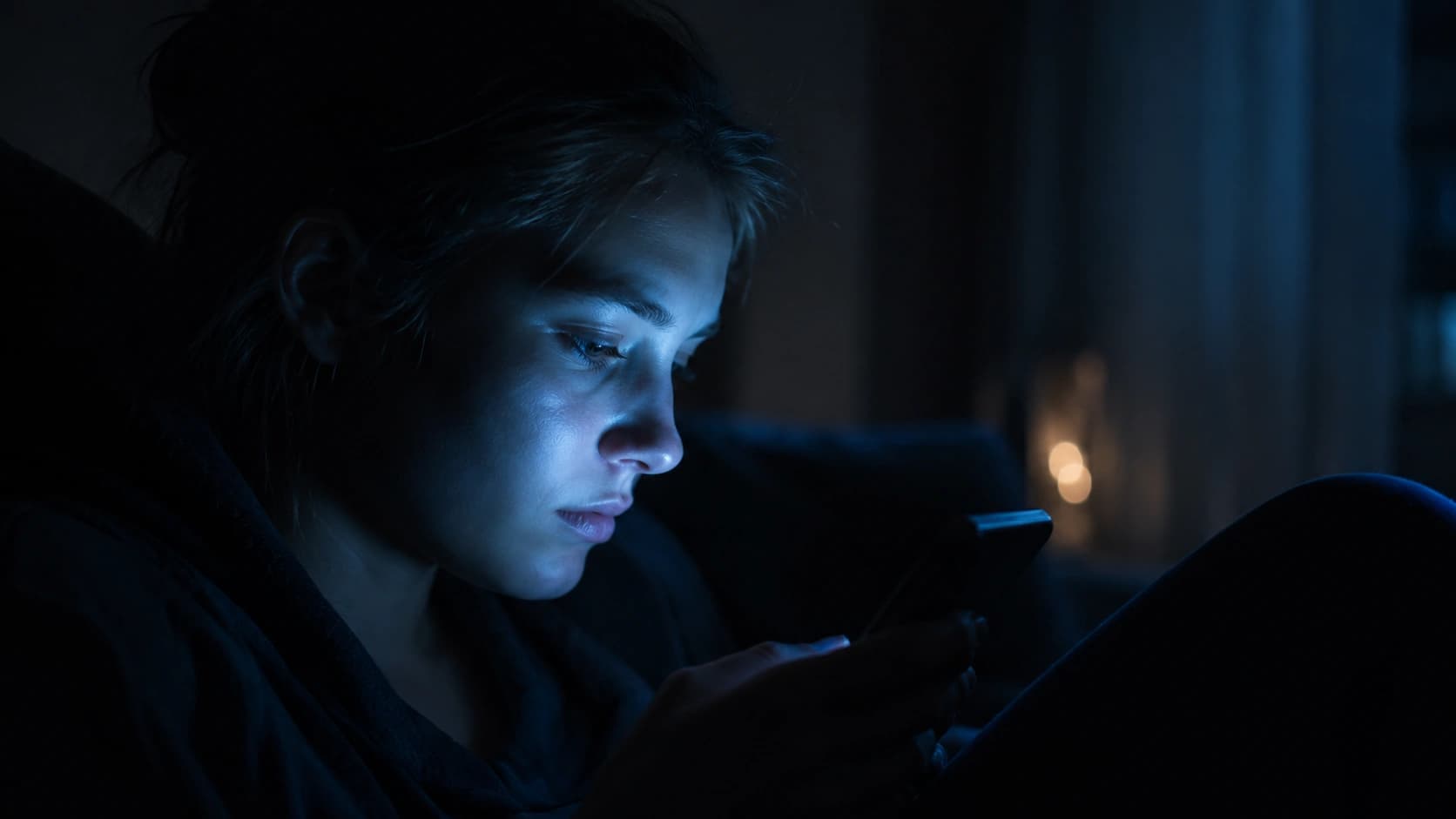
11:40 pm. You tell yourself: one more video, then sleep. Forty minutes later you are still scrolling. The screen lights up your face, the alarm is set for seven. And in the morning you will not remember a single clip from those forty minutes.
The feed holds you for a reason that has nothing to do with willpower. Experiments have pinned it down: the reward in a feed arrives unpredictably. One video is dull, the next is funny, the one after that is nothing. Your brain cannot guess which is coming, so it keeps checking. That unpredictability, not the content itself, is what makes scrolling sticky.
There is a second part to the answer, and it is awkward for most articles on this topic. Almost everything you have read about the four happiness hormones that social media hijacks has no research behind it. Numbers like "dopamine receptor sensitivity drops 23%" travel from article to article without a single link to an actual study. Below is what has genuinely been measured and what was invented. One especially stubborn number, the goldfish one, needs its own section.
What doom scrolling actually means
Doom scrolling is the long, barely controlled swiping through feeds of distressing news that leaves you feeling worse, yet somehow you cannot stop. The word combines doom and scrolling. It entered everyday speech around 2020 and reached research a little later.
The first measurement scale for doomscrolling was built in 2022, and in 2023 a team led by Seydi Ahmet Satici tested it across three groups: 378, 419 and 460 people, published in Applied Research in Quality of Life. Doomscrolling turned out to be consistently linked with psychological distress (a drawn-out state of tension where anxiety and low mood will not lift) and with lower life satisfaction.
Distressing news is not a requirement here. You can get stuck in harmless content too: recipes, cats, short comedy clips. The mechanism is identical. The only difference is how you feel when you finally close the app.
Why the feed works like a slot machine
Because it runs on variable reinforcement: the reward comes not every time, but now and then, without warning. Slot machines work the same way, and this is the most habit-forming reward schedule psychology knows about.
Picture two coffee machines. The first gives you coffee every time you press the button. Press, collect, walk away. The second pours coffee roughly one press in five, and you never know which press will pay off. You will keep pressing the second machine far longer than the honest one. A feed is the second machine.
This is measured behaviour, not a blogger's metaphor. In 2021 a team led by Björn Lindström published a study in Nature Communications built on an unusually large dataset: 1,046,857 posts from 4,168 people on Instagram and three discussion forums. People posted more often when likes were flowing and backed off when likes dried up. Their behaviour fit a mathematical model of reward learning, the same one used to describe how an animal learns to find food.
The researchers then tested it in the lab with 176 volunteers. Participants posted memes while the number of likes they received was secretly manipulated, anywhere from zero to nineteen. Behaviour shifted exactly as the model predicted.
There is a catch that usually gets lost in the retellings. Nobody measured dopamine. The authors state plainly that their behavioural findings cannot speak to the neurobiological basis. So it is established that you behave like a creature learning from unpredictable rewards. What your neurotransmitters (the chemicals brain cells use to signal each other) are doing at that moment is not something this study shows. That distinction does a lot of work in the rest of this article.
Why the four happiness hormones story falls apart
Because it has no sources. Checking the seven most widely repeated hormone statistics about scrolling led to no specific paper: no study, no author, no sample size. The link usually points to the PubMed or ScienceDirect homepage rather than to any research.
Here is what is wrong with each of them.
Serotonin. The popular version goes: a meta-analysis of 89 studies found lower serotonin in heavy social media users. The problem is technical. You cannot read serotonin levels in a living person's brain from an ordinary blood test, because serotonin in the blood and serotonin in the brain are separated by the blood-brain barrier. No study of that scale and design could be found.
Oxytocin. The claim that active Instagram users have 18% lower baseline oxytocin does not hold up either. The real research on oxytocin and Instagram is built differently: it looks at variants of the oxytocin receptor gene (OXTR) and how people carrying different variants behave online, how many accounts they follow, how much they post. That is not a measurement of hormone levels before and after scrolling.
Cortisol. The figure of 37% higher salivary cortisol has no traceable origin. Real measurements do exist, and they are more modest: in one study, salivary cortisol in students who received text messages did not differ significantly from control days.
Endorphins. The story about taking pleasure in other people's misfortune rests on a real concept, benign masochism (enjoying safe stress, the way people enjoy chilli peppers or horror films). But stretching it to scrolling and concluding that the endorphin system becomes exhausted is speculation, not measurement.
So why does everyone write about hormones? Because it sounds scientific and it takes no work: name a chemical, attach a percentage, done. Readers cannot easily check it, and the feeling of understanding arrives instantly. The bad news is that the feeling is false. The good news is that the real data exists, and it is both more specific and more useful.
How much time people actually spend in feeds
The global average is roughly 2 hours 21 minutes a day on social media, as of February 2025. That average hides an enormous spread between countries.
- EU and UK: about 1 hour 48 minutes a day, well below the global figure
- Philippines: about 3 hours 34 minutes
- Brazil: about 3 hours 37 minutes
- South Africa: about 3 hours 41 minutes, among the highest in the world
For teenagers the data is stricter. In 2024 the WHO Regional Office for Europe published the HBSC study: nearly 280,000 adolescents aged 11, 13 and 15 across 44 countries and regions in Europe, central Asia and Canada, surveyed in 2022. The share whose social media use qualifies as problematic (unable to control it, with clear negative consequences) rose from 7% in 2018 to 11% in 2022. Girls score higher than boys: 13% against 9%. More than a third of adolescents, 36%, reported being in near constant online contact with friends.
That WHO figure says more than any hormone story. A jump from 7% to 11% in four years is not about one teenager's weak character. It is about how the environment around all of them changed at once.
Is your attention span really 8 seconds, shorter than a goldfish?
No. This is the most famous invented fact about attention, and it deserves to be retired. The claim that humans manage 8 seconds against a goldfish's 9 spread from a 2015 Microsoft report. Neither number had a scientific source; they were simply printed next to each other in an infographic. Goldfish, incidentally, remember their way through a maze for months.
Real measurements exist, and they are more interesting. Gloria Mark, professor of informatics at the University of California, Irvine, has been timing how long people stay on one screen before switching since 2004.
- 2004: about 2.5 minutes
- 2012: about 75 seconds
- Recent years: about 47 seconds, with a median of 40
The distinction matters. Mark is not measuring the capacity of human attention. She is measuring how fast people switch between screens in a working environment, which is a different thing. She is also careful about causes: we do not know whether film and television reshaped our attention, or whether our attention reshaped film editing. What is clearer is that frequent switching is expensive, because every return to a task costs effort, and stress and errors climb along with it.
What scrolling does to your mood
The link to anxiety is real and shows up across cultures, but it is weaker and more tangled than headlines suggest.
In 2024 Computers in Human Behavior Reports published a cross-cultural study of 620 students in Iran and 180 in the United States. The higher a person's doomscrolling, the higher their existential anxiety (anxiety attached not to a specific problem but to a sense that life itself is unstable). The strength of the link was nearly identical in both countries: 0.38 in the Iranian sample and 0.33 in the American one. Doomscrolling also predicted a bleaker view of human nature generally.
Now the honest limits. These were students, not the general population. The data was collected at a single point in time, so the direction cannot be established: scrolling may fuel anxiety, or anxious people may scroll more. Most likely both happen at once.
Another result rarely gets placed beside that one. When Amy Orben and Andrew Przybylski ran three large adolescent datasets, screen time explained roughly 0.4% of the variation in wellbeing. For comparison, that is about the same as regularly eating potatoes, and less than wearing glasses. In other words, hours on a screen is close to a useless measure.
How does that sit with the doomscrolling findings? What you do matters far more than how long you do it. An hour on a video call with someone you love and an hour scrolling disasters are two very different hours, but screen time statistics add them into one number where they cancel each other out. So the sensible goal is not spending less time on your phone. It is changing what you spend it on.
What actually works, with real numbers
Boring things work, the ones that change your environment rather than your willpower. Below is only what has been tested, with the honest size of each effect.
1. Switch your screen to greyscale. In an experiment by Cynthia Dekker and Susanne Baumgartner, 84 participants spent 6 days as usual and 6 days with a grey screen. Screen time fell by around 20 minutes a day, sense of control over the phone rose, and stress dropped. But honestly: the number of unlocks did not change, and neither sleep nor productivity improved. Other studies find larger effects, between 22 and 50 minutes a day. The setting takes a minute to find in accessibility options.
2. Get the phone out of the bedroom. In a small randomized trial of 38 people, participants avoided their phone for 30 minutes before bed for four weeks. They fell asleep faster, slept longer, and reported better sleep quality, along with improved mood and working memory. The sample is small, so treat this as promising rather than settled. A classic 2015 PNAS study adds weight: screen light before bed suppresses melatonin (the hormone that tells your body it is time to sleep), shifts your internal clock, and leaves you less alert the next morning.
3. Do not switch notifications off entirely. Batch them. Here the popular advice gets it wrong. In a study of 221 people, a week with notifications on produced more symptoms of inattention and restlessness than a week without. But switching them off completely raised anxiety and fear of missing out. The workable answer sat in between: in a two-week experiment, participants who received notifications in three batches a day ended up calmer and happier, because the subjective quality of their attention improved.
4. Cap screen time at two hours a day. In 2025 BMC Medicine published a randomized trial of 111 students whose baseline screen time averaged 276 minutes a day. The group that stayed under two hours for three weeks improved on depressive symptoms, stress, sleep quality and overall wellbeing. Effect sizes ran from small to medium: noticeable, not miraculous.
That study has a sequel worth knowing in advance. Once the experiment ended, screen time climbed back quickly and the mental health measures drifted back with it. The lesson is not that detoxes fail. It is that a one-off sprint achieves nothing if the environment afterwards is unchanged. What works is what you change permanently: where the phone sleeps, what colour the screen is, when notifications arrive.
What this means for you
The feed catches you with a real mechanism, not an invented one. Unpredictable reward is a measured fact, and it explains the stickiness completely, with no mystique about four hormones. It also settles the question of blame: you did not lose a duel with your own biology. You sat down opposite a system that was tuned for years to produce exactly this behaviour.
Which points to something practical. If the problem lives in the environment, then the environment is what you change, not your character. A grey screen, a charger in another room, notifications in batches: each is modest on its own, but each keeps working for as long as it is in place, and none of them demands heroism.
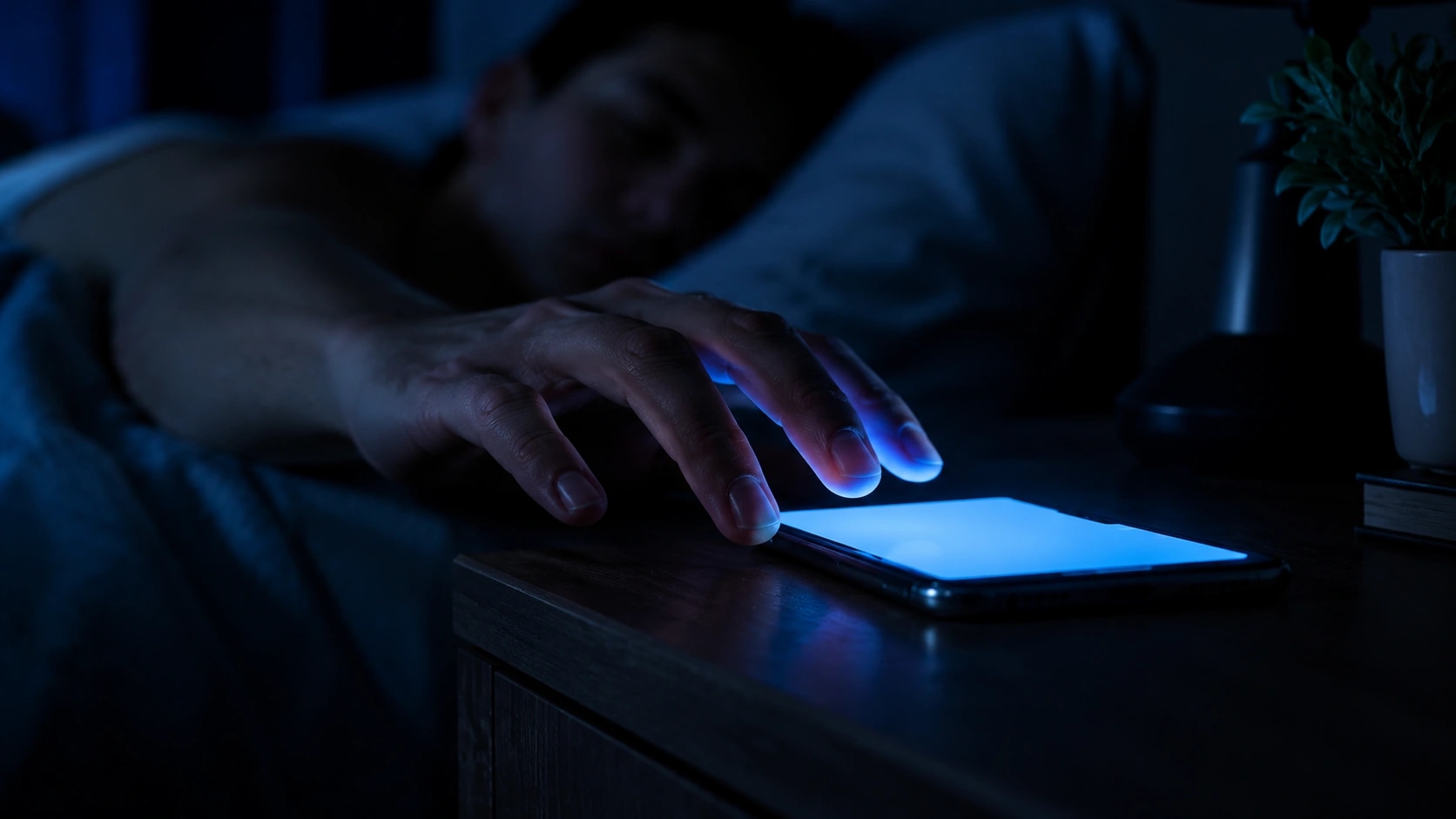
Your micro-step for today takes two minutes. Tonight, plug your phone in somewhere other than beside your bed: another room, or at least the far side of the bedroom. If you need the alarm, set it now and then carry the phone to a spot you would have to stand up to reach. Nothing else is required today.
And tomorrow at 11:40 pm, when your hand reaches for the nightstand out of habit, there will simply be nothing there.
Sources
WHO Regional Office for Europe. Teens, screens and mental health: HBSC report (2024)
Satici S.A. et al. Doomscrolling Scale. Applied Research in Quality of Life (2023)
Gloria Mark. Why our attention spans are shrinking. American Psychological Association (2023)
Restricting bedtime mobile phone use: a randomized pilot trial. PLOS One (2020)
Chang A.M. et al. Evening use of light-emitting eReaders and melatonin. PNAS (2015)
Orben A., Przybylski A.K. Screens, Teens, and Psychological Well-Being. Psychological Science (2019)