For informational purposes only. This article does not replace professional medical advice and is not intended for self-diagnosis or self-treatment. Consult a qualified healthcare provider before making health-related decisions.
A student leaves class for five minutes. In their pocket sits a device the size of a USB stick: it smells like mango, makes no smoke, leaves nothing on clothing. Their parents find out a year later, by accident.
There are at least 15 million teenagers like that worldwide. That is the first global estimate WHO has ever published for e-cigarettes, released in October 2025: 86 million adults and 15 million children aged 13-15, more than 100 million people in total. In countries with data available, children vape on average nine times more often than adults.
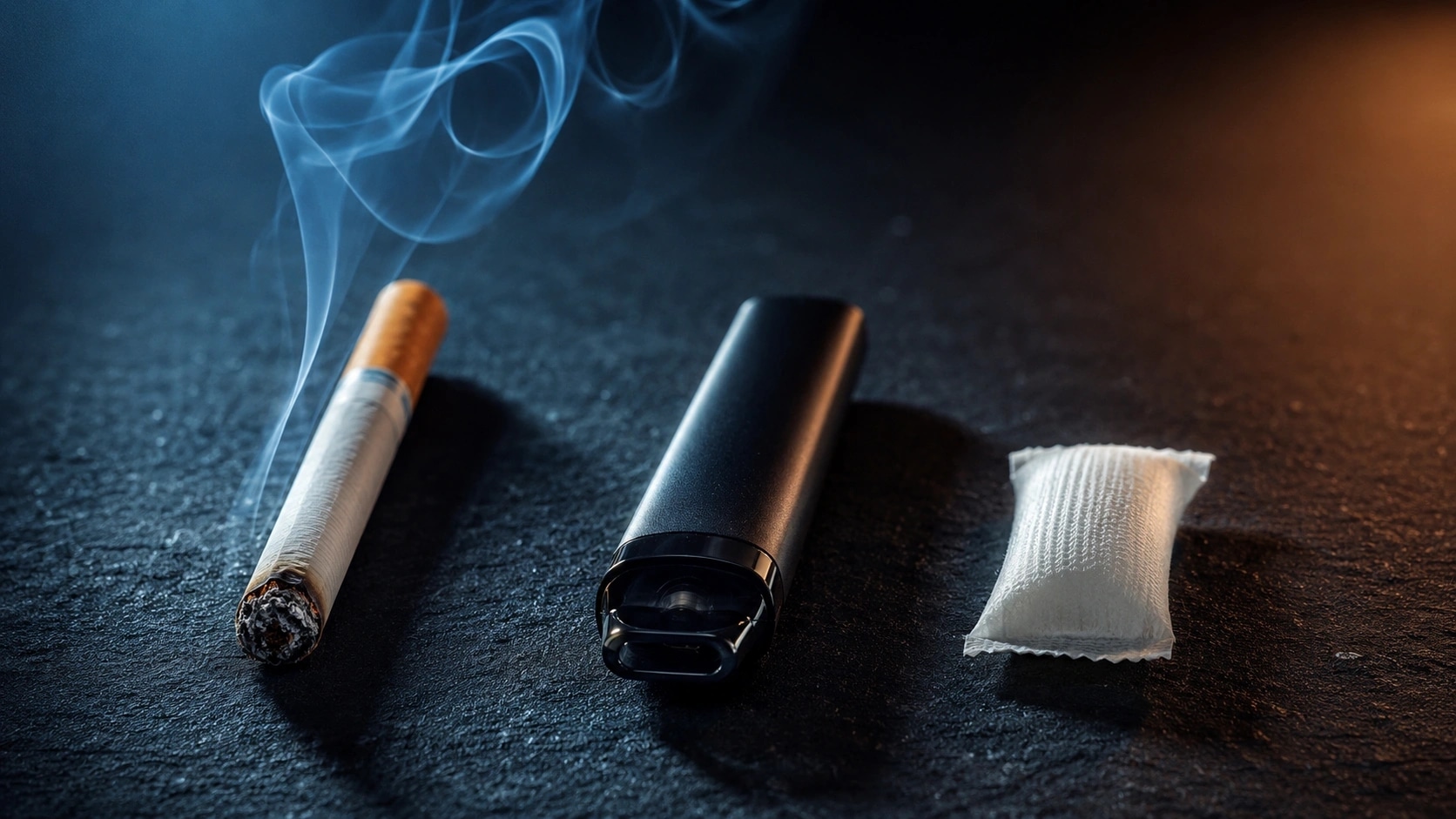
There is no safe form of nicotine. That is the short answer. But the familiar follow-up - "so it is all equally bad" - is wrong too, and that second mistake costs people just as much as the first. The gap between a cigarette, a vape and a pouch under the lip is real and measurable. The catch is that every time such a gap appeared, it got turned into an advertisement aimed at people who did not use nicotine yet. That happened with the filter. It happened with the hookah. It is happening now, and the strangest twist in the story shows up near the end.
Why the tobacco plant makes nicotine at all
Nicotine is a poison a plant uses against anything that tries to eat it. Wild tobacco, Nicotiana attenuata, produces nicotine in response to damage. The signal comes from jasmonates (plant stress hormones - the chemicals that switch on defences when a leaf gets bitten or torn). The harder the plant is grazed, the more nicotine moves into its stems and leaves.
Researchers tested this directly. Genetically modified tobacco that could not produce jasmonates was attacked far more often, by insects and by mammals alike. Wild rabbits pick the low-nicotine shoots and walk past the ones loaded with it.
So people are consuming a substance evolution built as a neurotoxin (a poison that acts on the nervous system) for six-legged animals. In an insect, nicotine jams nerve signalling and kills within minutes. In humans the same receptors behave differently, so the damage stretches across decades instead. Same mechanism. Different dose, different speed.
But poison was not the first thing Europeans saw in tobacco. First they saw medicine.
Tobacco spent 250 years being sold as medicine
Tobacco entered European medicine before it entered European daily life, and it stayed there far longer than most people assume. In 1560 Jean Nicot, the French ambassador in Lisbon, sent tobacco seeds and leaves to Paris and offered them to the queen mother, Catherine de' Medici, as a remedy for migraine: the leaves were ground into powder and inhaled through the nose. The remedy caught on at court, and the fashion for medicinal tobacco spread with it.
The diplomat's name stuck permanently. The plant became Nicotiana tabacum, and the alkaloid extracted from it (a natural plant compound, usually strongly active in the body) became nicotine.
Then it got stranger. In eighteenth-century London, tobacco smoke was blown into the rectums of drowning victims, on the theory that smoke warmed the body from inside and restarted breathing. Physicians William Hawes and Thomas Cogan founded a society for rescuing the drowned that became the Royal Humane Society, and in the 1780s it installed resuscitation kits along the Thames, complete with tubes for tobacco smoke enemas. The kits sat in churches and pharmacies the way defibrillators do today. A successful rescue paid four guineas.
The first warning came in 1761. London surgeon John Hill described ulcerated cancers of the nose in men who had used large amounts of snuff for years, and published a pamphlet cautioning against it. It is the first clinical report linking tobacco to cancer. Nothing changed. Tobacco kept being prescribed and sold in pharmacies.
Pure nicotine was not isolated until 1828, by the German physician Wilhelm Posselt and the chemist Karl Reimann. Only then could the substance be studied apart from the plant. And that is where a confusion began that is still with us.
Does nicotine cause cancer? The precise answer
Nicotine does not start cancer, but it helps a tumour grow. That is not word-play; those are two different mechanisms, and separating them matters.
A carcinogen (a substance that damages DNA so a cell mutates and turns cancerous) is an initiator. Nicotine is not one: it does not cause the first mutation in humans or in rodents. What it does is bind to nicotinic acetylcholine receptors on cell surfaces and do four things at once - push cells to divide, stop damaged cells from dying on schedule, help a tumour grow its own blood supply, and dampen the immune response. Put simply, it does not fire the starting gun. It prepares the ground and then feeds whatever grows there.
So where are the real carcinogens? A common claim says the liver converts nicotine into three powerful carcinogens. That is wrong. The liver turns nicotine into cotinine, a harmless marker used to check whether someone has been smoking. The major tobacco carcinogens, the nitrosamines NNK and NNN, form in the leaf rather than in the body - during curing, fermentation and storage, when bacteria generate nitrites that react with tobacco alkaloids. Fresh leaves contain none at all; the compounds appear a few days after harvest.
The second source is combustion. Cigarette smoke contains more than 7,000 chemical compounds, and about 70 of them are recognised carcinogens. Not 5,000, as the figure is often repeated, but over seven thousand.
The practical conclusion annoys both sides of the argument. Nicotine without combustion is not a harmless habit: it strains blood vessels, raises blood pressure and heart rate, and in teenagers it interferes directly with brain development. But it is not the same thing as smoke either. Most of the cancer burden comes from the packaging, not from the drug.
That gap is exactly what every "safer smoking" product has been built on. The first attempt was the filter.
The filter: the first "safe solution" that made things worse
The filter was invented to rescue a market, not a pair of lungs. In December 1952 Reader's Digest ran Roy Norr's article "Cancer by the Carton", and cigarette sales fell for the first time since the Great Depression. In the early 1950s Richard Doll and Austin Bradford Hill launched the British Doctors Study, which tied smoking to lung cancer with data rather than suspicion.
The industry answered on 4 January 1954. More than 400 US newspapers carried "A Frank Statement to Cigarette Smokers", drafted by the PR firm Hill & Knowlton. The message: there is no proof, the science is unsettled, we care about you. Roughly 43 million people saw it. That page established a playbook used for decades afterwards - do not refute the evidence, just keep doubt alive.
Filtered cigarettes reached the shelves at the same time, and sales recovered. What happened next is the part most people never hear.
From the mid-1960s, filters were perforated with ventilation holes. Air mixes with the smoke, so the testing machine records less tar. By the late 1960s about 7% of cigarettes had ventilated filters; by 1982 it was 94-100%. A smoker getting a weaker puff compensates without thinking about it: deeper, longer, more often. A 2017 review in the Journal of the National Cancer Institute put a number on it - smokers of low-yield ventilated cigarettes took in about 2.5 times more tar, nicotine and nitrosamines than the machine yield suggested.
Deeper puffs carry smoke into the periphery of the lungs, the smallest passages it barely used to reach. A different tumour started growing there. Between the 1960s and the 1980s the relative risk of lung adenocarcinoma rose from 4.6 to 19.0 in men and from 1.5 to 8.1 in women - while overall smoking rates were falling. The 2014 US Surgeon General's report linked that rise directly to changes in cigarette design.
The score for the first attempt at safer smoking: toxin dose did not drop, it moved deeper into the lungs, and the dominant cancer type shifted to one that is harder to treat. And the filter did exactly what the advertising promised - it genuinely lowered machine-measured tar. The device did not lie. The way it was sold did.
Who taught the world to smoke: women, Hollywood and Freud's nephew
Smoking went mass-market through engineering and advertising, not habit. In 1881 James Bonsack patented a machine that rolled 200 cigarettes a minute, roughly 60 times faster than a skilled hand-roller. Costs collapsed, volumes exploded, and within decades the market consolidated into a handful of giants. After that, the only way to grow was outward - toward people who did not smoke yet.
Women were the first such audience. In 1923 they accounted for around 5% of cigarettes sold in the United States. Edward Bernays, a public relations man and Sigmund Freud's nephew, set out to remove the social taboo. On advice from psychoanalyst Abraham Brill, he proposed linking the cigarette not to vice but to male power that women were in the process of claiming.
On 31 March 1929, during the Easter parade on New York's Fifth Avenue, a group of women lit Lucky Strikes in full public view. The stunt was called "Torches of Freedom". The next day The New York Times ran it on the front page: "Group of Girls Puff at Cigarettes as a Gesture of 'Freedom'." No coverage mentioned Bernays, the American Tobacco Company or the brand. By 1929 women's share of the market had reached 12%.
When the United States banned cigarette advertising on television in 1971, the industry moved where no ban existed. Internal company documents unsealed through litigation in the 1990s showed the mechanics. Between 1979 and 1983, Brown & Williamson spent more than $950,000 placing its brands in over 20 films. In a letter dated 28 April 1983, Sylvester Stallone agreed, for a fee of $500,000, to use the company's tobacco products in no fewer than five feature films. Much of the money arrived as goods: a $97,000 car, an $80,000 horse, jewellery, a watch.
Worth pausing here. The point is not that films "showed smoking". The point is that individual scenes were bought by contract, with a minimum film count written in. The same logic runs today, with creators instead of studios and a device on the desk instead of a pack in frame. The addiction business rarely invents anything new: the same playbook shows up in loot boxes and gambling.
Alongside the advertising, a second layer of mythology was under construction: gentler ways to take nicotine. Those myths have proved remarkably hard to kill.
Hookah and snus: the two most durable myths
Both products rest on one idea: no familiar smoke in the lungs means almost no harm. Both times the idea fails, for different reasons.
Hookah. The water in the bowl does not filter toxins. It cools the smoke, which feels like mildness, and that is precisely why people take more puffs. An hour-long session means inhaling 100 to 200 times the smoke volume of a single cigarette: roughly 90,000 ml against 500-600 ml. In one session a person takes in nearly nine times more carbon monoxide and about 1.7 times more nicotine than from one cigarette. The carbon monoxide comes from the charcoal as well as the tobacco, and it does not dissolve in water at all.
People often say an evening of hookah equals three packs of cigarettes. For nicotine that overstates it. For smoke volume and carbon monoxide it understates it. A more accurate framing: hookah is not a lighter format but a different harm profile, where carbon monoxide and charcoal combustion products replace tar as the headline problem. Plus a shared mouthpiece, which spreads infections.
Snus and nicotine pouches. Here the usual comparison mixes up two different measurements. "One pouch holds 22 mg of nicotine versus 1.5 mg in a cigarette" sounds devastating, but it compares what a product contains against what a cigarette delivers.
What the research actually shows:
- A cigarette contains roughly 10-15 mg of nicotine and delivers about 1-2 mg into the blood.
- A pouch typically contains 3-20 mg, of which roughly a third to a half is absorbed.
- Peak blood concentration arrives in 5-8 minutes from a cigarette, and in 20-65 minutes from a pouch.
- Common 4 mg pouches deliver total nicotine exposure similar to a cigarette, only slower and without the spike.
What follows from that. A pouch is not "15 times stronger" than a cigarette; that myth comes from an invalid comparison. But it is not a harmless sweet either: the dose is comparable, dependence forms, and the mouth lining takes direct contact, which brings inflammation and gum recession (when the gum pulls back and exposes the tooth root). Snus is linked to cancer of the mouth.
The separate problem is invisibility. A pouch can sit in a mouth through a whole lesson and nobody notices. Regulators keep chasing the category: bans arrive, formulations and product names change faster than legislation passes.
And here the story gets genuinely contested. Because the next product was not simply another deception.
Vaping: why both sides of the argument are right
The e-cigarette is a rare case where two opposite positions are supported by evidence at the same time. That is why the argument has run for fifteen years without resolution.
Side one: as a way to quit smoking, vapes work. The Cochrane review (an international body that pools results from all good-quality studies on a question) was updated in 2025: 104 studies, 30,366 participants. High-certainty evidence shows nicotine e-cigarettes help people stop smoking more often than conventional nicotine replacement therapy such as patches and gum. In absolute terms that is roughly three extra quitters per 100 people. Rates of adverse events were comparable.
Cancer Research UK states it just as plainly: research so far shows that vaping with legal e-cigarettes is less harmful than smoking, and that they are an effective stop-smoking tool.
Side two: as a product for new customers, vapes work even better. Those 15 million children aged 13-15 in the WHO report are not a side effect, they are the design working. Mango instead of bitterness, no cough on the first draw, a device that charges and adjusts like any other gadget, and a smell parents cannot detect. A teenager has no prior smoking to reduce. For them it is not a substitute. It is the entrance.
Nicotine in adolescence hits a brain that is still under construction. The US Surgeon General's report on youth e-cigarette use records this as a standalone conclusion: nicotine exposure during adolescence can cause addiction and can harm the developing adolescent brain.
Both sides are working from real data. The only difference is who they are talking about: a forty-year-old with a twenty-year smoking history, or a fourteen-year-old who never smoked. The same product means opposite things to those two people.
And now the promised twist, which is not about vapes at all. It is about us.
The pendulum swung the other way, and that is a problem too
Public opinion has now got it wrong twice in a row, in opposite directions. A survey of roughly 27,000 smokers in Great Britain tracks the shift: in April 2015, 35% believed vaping was less harmful than smoking, 35% thought it equally harmful and 14% more harmful. By April 2025 the picture had flipped - only 12% saw it as less harmful, while 38% now considered it more harmful than smoking cigarettes.
In plain terms, the most common error today is no longer "vaping is safe". It is the reverse. And it has a price: a smoker convinced that switching changes nothing simply keeps the cigarette. The evidence says otherwise, because there is no combustion in a vape, and therefore no tar and none of most combustion products.
This is the filter trap again, only mirrored. Back then the benefit was oversold and adenocarcinoma followed. Now the harm is oversold and adult smokers stay on the most dangerous option available. The careful phrasing is dull but accurate: vaping is less harmful than smoking, it is not harmless, and it is not for people who do not smoke.
Two specific fears about vaping deserve unpacking, because one of them was confirmed and the other was not.
EVALI and "popcorn lung": what actually happened
One of these conditions was real and killed people; the other has never been confirmed in a single case. They get mentioned in the same breath constantly, and that damages the conversation in both directions.
EVALI was a real outbreak. E-cigarette or vaping product use-associated lung injury began in the United States in July 2019. By February 2020 it accounted for 2,807 hospitalisations and 68 deaths, many of them young people. The cause turned out to be vitamin E acetate, an oily additive mixed into illicit cartridges containing THC (the active compound in cannabis). It showed up in product samples and in lung fluid from patients, and was absent in people without the illness.
The detail usually left out: this was mainly about black-market THC cartridges, not legal nicotine liquids. That does not make vaping safe. It explains why the outbreak was sharp, geographically specific and ended once one additive was removed. It also exposes the category's central weakness - formulations are not standardised, oversight is far lighter than for medicines, and the next stray additive could do the same thing.
Popcorn lung has not been confirmed. Bronchiolitis obliterans (irreversible scarring of the smallest airways) got its nickname in the early 2000s when workers at a microwave popcorn plant fell ill after inhaling diacetyl, a butter-flavour compound. Diacetyl really was found in vape liquids: a 2015 Harvard study detected it or related compounds in 47 of 51 samples tested.
But there are no confirmed cases of popcorn lung linked to e-cigarettes. Cancer Research UK says exactly that. Diacetyl has been banned in e-liquids across the UK and EU since 2016. A handful of bronchiolitis cases in vapers have been described, but none has been convincingly traced to diacetyl.
Why bother correcting this, when vaping is not good for anyone anyway? Because a teenager only needs to catch an adult exaggerating once to stop believing everything else - including the parts that are true. Scaring people with inaccuracies costs more than stating the facts.
How many people use nicotine now: the world map
Smoking is down, and the epidemic is nowhere near finished. WHO estimates that in 2024 one in five adults on the planet used tobacco: 1.2 billion people, against 1.38 billion in 2000. Prevalence has fallen roughly 27% since 2010, but the absolute number dropped far less, because the world population grew.
The regional spread is enormous:
- Africa - 9.5%, the lowest rate in the world.
- The Americas - about 14%.
- Eastern Mediterranean - about 18%.
- Western Pacific - 22.9%, with 43.3% among men and 2.5% among women.
- Europe - 24.1%, the highest region, and 17.4% among women, also a world maximum.
- South-East Asia - 37% among men, down from 70% in 2000.
Individual countries diverge even further. In Indonesia around 60% of men smoke, against just over 1% of women. India reports adult smoking prevalence near 9%, though the picture there is shaped by smokeless tobacco. A systematic review across seven Latin American countries found adolescent e-cigarette use averaging 18.9%, with individual samples ranging from 2.6% to 64.2%. In the United Kingdom roughly 30% of 16-24-year-olds vape. In Russia tobacco smoking prevalence fell from 24.2% in 2019 to 19.2% in 2022 and 18.6% in 2024, about half the level of fifteen years ago.
The overall pattern: the cigarette is retreating almost everywhere. Nicotine is not. It is changing carrier.
What happens to the body when nicotine leaves
Recovery starts within the hour, not within years. This is the one part of the subject where the news is good, and it is worth knowing in advance - because the first days without nicotine are hard, and it helps to know what you are enduring them for.
Why they are hard: nicotine's half-life is 1 to 3 hours, so roughly two hours after a cigarette half of it is gone from the blood. A brain used to regular top-ups responds with irritability and craving within hours. The peak lands on day two or three, and symptoms fade over three to four weeks after that. The hard part is not months. It is the first 72 hours.
What follows, according to WHO:
- After 20 minutes, heart rate and blood pressure drop.
- After 12 hours, carbon monoxide in the blood returns to normal.
- After 2-12 weeks, circulation improves and lung function increases.
- After 1-9 months, coughing and shortness of breath decrease.
- After 1 year, the risk of coronary heart disease is about half that of a smoker.
- After 10 years, the risk of lung cancer falls to about half that of a smoker.
- After 15 years, coronary heart disease risk matches that of someone who never smoked.
And the headline number. Quitting at 30 adds nearly 10 years of life expectancy, at 40 about 9 years, at 50 about 6, at 60 about 3. It is never too late, but each decade of delay costs roughly three years.
What actually helps: nicotine replacement therapy, prescription medication, support from a specialist, and for people who have tried and failed, switching to e-cigarettes as a stage rather than a destination. The same slow-creep pattern applies to any stimulant the body quietly adapts to: energy drinks work much the same way.
So is there a safe form of nicotine?
No. But the more useful thing to carry around is the whole formula: no form is safe, the forms do differ, and that difference is what gets sold.
The filter really did cut tar, and drove up adenocarcinoma. The water in a hookah really does cool the smoke, and that is why people inhale a hundred times more of it. Vaping really is less harmful than smoking, and it has already delivered nicotine to 15 million children who would never have lit a cigarette. Every time, a genuine technical improvement became an advertising argument, and the advertising argument became a new market.
The student from the first paragraph does not consider themselves a smoker. In their version of events they do not smoke; they vape mango. A year from now they will notice they cannot sit through a two-hour class, and that will be the first time they think about it.
There is one small thing to do today. Delay your next puff by 20 minutes and write down in your phone what triggered it: coffee, an empty lift, an argument, boredom, someone else's smoke. One line, one trigger. That gives you something to work with, because the habit does not run on nicotine alone - it runs on the link between a situation and a hand reaching into a pocket, and you cannot see that link until you write it down.
Sources
- WHO global tobacco trends report (October 2025)
- WHO fact sheet: Tobacco and nicotine
- WHO: health benefits of smoking cessation by timeline
- Cochrane review: electronic cigarettes for smoking cessation (2025)
- Journal of the National Cancer Institute: filter ventilation and rising lung adenocarcinoma (2017)
- Cancer Research UK: does vaping cause popcorn lung
- CDC MMWR: final characteristics of the US EVALI outbreak (2019-2020)
- CDC: chemicals and carcinogens in tobacco smoke
- US Surgeon General: e-cigarette use among youth, nicotine and brain development
- Systematic review: adolescent e-cigarette use in Latin America (2024)
- Our World in Data: vaping versus smoking and harm perceptions, 2015-2025
- UCSF Smokefree Media: Brown & Williamson film placement documents
- British Columbia Medical Journal: the history of tobacco smoke enemas
- Plant Physiology: jasmonates, nicotine biosynthesis and herbivore resistance