For informational purposes only. This article does not replace professional medical advice and is not intended for self-diagnosis or self-treatment. Consult a qualified healthcare provider before making health-related decisions.
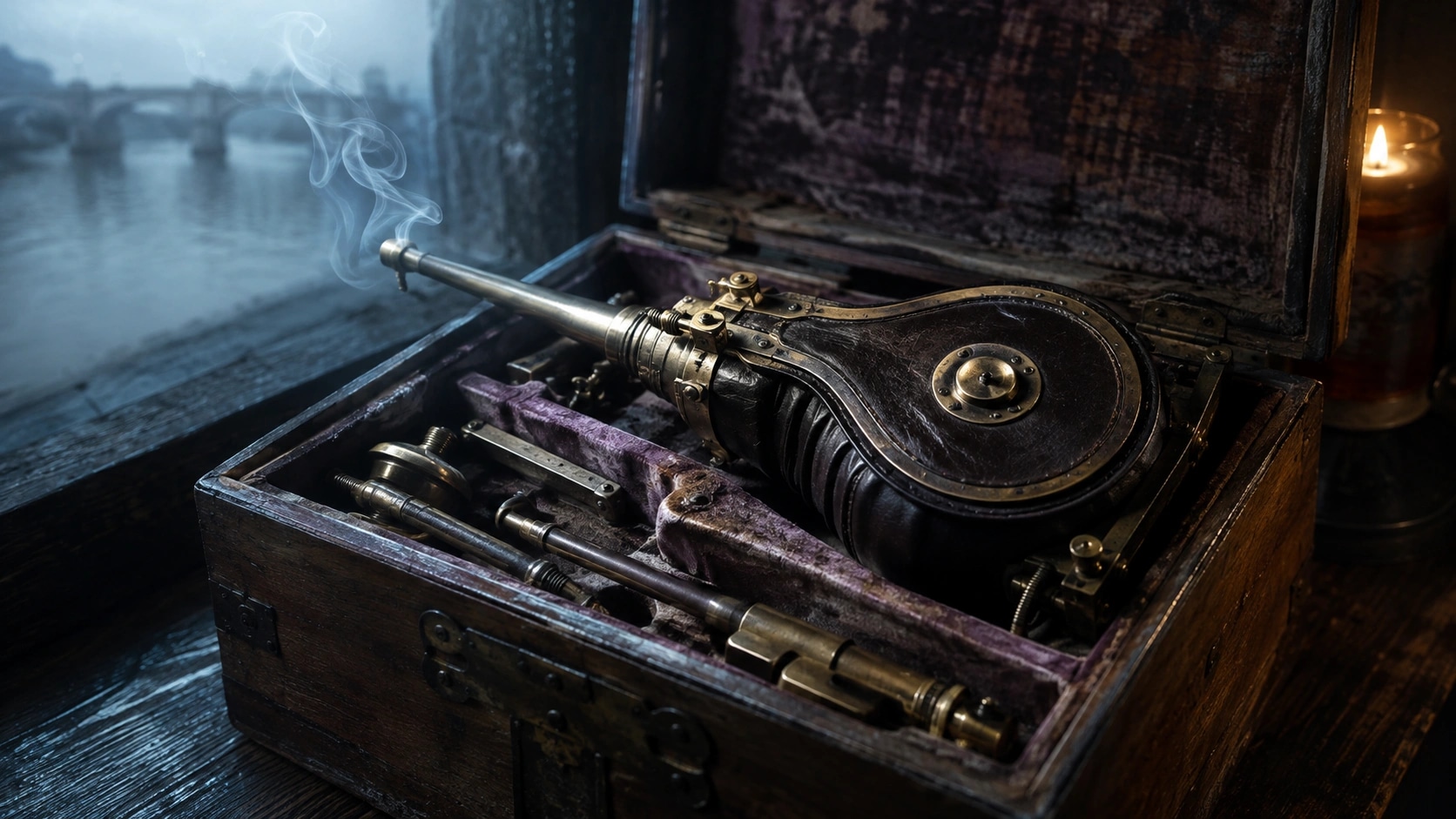
London, late 1700s. A drowned man is pulled from the Thames. A rescuer runs to a wooden box on the embankment, pulls out a leather bellows with a tube, inserts the tube into the man's rectum and starts pumping tobacco smoke into him. This was not cruelty or a prank. It was the official resuscitation protocol, funded by a respected medical society.
The scariest medical treatments in history are procedures that were once considered normal medicine but had no proof they worked, and often caused harm. Tobacco smoke enemas, bloodletting, lobotomy, radium water. Here is the key thing to understand: doctors of the past were not stupider than we are. They simply had no way to test whether a treatment worked. And here is the uncomfortable part - several of the most revolting-looking methods are officially approved today and save lives, while one of the most respectable won a Nobel Prize and damaged tens of thousands of people.
Let's walk through what people were treated with in the past, what survived, and most importantly how to tell today's "weird but works" from today's "weird and dangerous". At the end there is a five-minute way to check any treatment yourself.
Smoke up the rectum: how the tobacco enema became standard rescue
Tobacco smoke enemas were used to revive drowning victims because doctors believed the smoke warmed the body from inside and restarted breathing. The method came to Europe from the Indigenous peoples of North America, who used tobacco as medicine. East India Company surgeon John Woodall described it as early as 1639.
Then came the part that makes this story genuinely strange: the method did not stay folklore. It became official.
In 1774 physicians William Hawes and Thomas Cogan founded a London society to help "persons apparently dead from drowning" - later the Royal Humane Society. In the 1780s the society placed rescue kits along the Thames, and inside them sat those bellows with a rectal tube. A successful rescue earned 4 guineas, roughly 160 dollars in today's money.
At first an assistant drew smoke into his own lungs and blew it in by mouth. The bellows came later, and not out of squeamishness: a cough at the wrong moment meant inhaling the contents of someone else's bowel, and during a cholera outbreak that meant catching cholera.
The method quickly spread beyond drowning. Tobacco enemas were used for headaches, colds, hernias, abdominal cramps, typhoid fever and cholera. A procedure for one rare emergency turned into a cure-all - the standard path of every fashionable treatment without evidence.
It ended in 1811. English scientist Benjamin Brodie ran experiments and showed that nicotine is toxic to the heart. The smoke that was supposed to restart the heart was actually stopping it. The Royal Humane Society dropped the method in the early 19th century.
But the bigger question is not the enema itself: why did educated, well-meaning doctors do this for a century and a half without noticing it did not work?
Why smart doctors believed nonsense: the theory that lasted 2,000 years
Doctors believed in strange treatments because they had a tidy theory and no way to test it. The theory was humoral (from the Latin humor, meaning fluid): the body was thought to contain four fluids - blood, phlegm, yellow bile and black bile. Illness meant the balance was off. So the excess had to come out.
Hence bloodletting. The logic is flawless: if there is "too much" blood, remove some. The idea came from ancient Egypt, was cemented by Hippocrates and Galen, and ruled medicine for more than two thousand years. Galen considered blood the dominant fluid, the one most in need of control.
The problem was not stupidity but the missing tool. Imagine bleeding a hundred patients. Sixty recover, because the body healed itself. Forty die, because "the disease was too advanced". Both outcomes confirm the theory. Without a comparison group - people who were not treated - telling help from harm is impossible in principle.
That tool arrived only in the 19th century. French physician Pierre Louis started counting. He compared how illness ran in patients who were bled and patients who were not. The conclusion was unpleasant: bloodletting worked far worse than everyone assumed. That is the seed of all modern evidence-based medicine. Do not ask whether a method sounds logical. Ask what the comparison showed.
And this is where the story gets awkward. Because even after that tool existed, medicine still managed to hand out a Nobel Prize for a catastrophe. Twice in 22 years, in fact - and the first time the prize was deserved.
Infect them with malaria to cure syphilis: the strange method that worked
Malaria was used to treat late-stage syphilis, and it genuinely saved some patients - which is why Austrian psychiatrist Julius Wagner-Jauregg won the Nobel Prize in Medicine in 1927.
It sounds insane, but the logic came from an observation. Wagner-Jauregg noticed that a psychotic patient came back to his senses after a severe fever. Before antibiotics, neurosyphilis (when the bacterium reaches the brain and the person loses their mind) meant certain death. There was no treatment at all.
The mechanism turned out to be real. The bacterium Treponema pallidum struggles above 37 degrees Celsius, and malarial fever pushes the body to 41. Doctors deliberately infected patients with malaria, let them go through a series of fever attacks, then treated the malaria itself with quinine.
The numbers are both honest and grim. A 1926 review found full remission (the disease gone completely) in about 27.5% of cases, partial remission in 26.5%, and no change or death in 46%. Roughly 20% of patients died from the treatment itself.
One in five killed by the therapy, and it counted as a breakthrough. Because the alternative was everyone dying.
The method faded on its own. About a year after the Nobel Prize, Alexander Fleming spotted Penicillium mould, and by mid-century antibiotics were widely available. Nobody infects a person with malaria when a penicillin shot exists.
Hold on to the key point here: the method was strange and dangerous, and it was still the best available at the time. Now look at what happens when the prize goes to a method that was not the best available.
A Nobel Prize for lobotomy: medicine's most expensive mistake
Lobotomy - an operation that severed the nerve fibres between the frontal lobes and the rest of the brain - earned Portuguese neurologist Egas Moniz the 1949 Nobel Prize and damaged more than a hundred thousand people worldwide.
Moniz developed prefrontal leucotomy in 1936 with neurosurgeon Almeida Lima. At first the brain's white matter was destroyed with alcohol; later came a purpose-built instrument, the leucotome, which cut six cores of tissue in each hemisphere.
The idea looked humane. Psychiatric hospitals of the 1930s were full of people with severe psychosis for whom nothing existed: no medication, no therapy, only restraints and lifelong confinement. Surgery promised to give them a calm life back.
The price was this:
- seizures in 23% of patients;
- chronic headaches in 15%;
- death from the operation itself in about 5%;
- irreversible personality change: apathy, emotional flatness, loss of will and initiative.
The patient stopped raging. The patient also stopped being themselves.
Then it got out of hand. American doctor Walter Freeman simplified the operation into a "transorbital" version: the instrument went in through the eye socket, with no neurosurgeon and no operating theatre. In the United States lobotomies rose from about 500 a year in 1946 to 5,000 in 1949. By August 1949 roughly 10,000 had been performed nationwide. Freeman personally operated on some 2,500 people across 23 states before his death in 1972.
What stopped it was not public outrage. It was a pill. Chlorpromazine, the first effective antipsychotic drug, arrived in 1952. By the 1960s lobotomy had essentially ended.
The Nobel committee has never withdrawn the 1949 prize, despite repeated calls to do so.
Compare the two cases. Malaria therapy: strange, terrifying, 20% mortality - but the best option available, and it vanished the moment something better appeared. Lobotomy: also terrifying, also called the best available - but scaled to a hundred thousand people without anyone counting the results properly. The difference is not how gruesome the procedure looks. The difference is whether anyone honestly counted.
The pharmacy as a poison source: radium water and heroin for children
The most dangerous strange treatments were not sold by village healers. They were sold officially, in pharmacies, with advertising and a quality guarantee.
Radium water. Radithor was triple-distilled water containing radium-226 and radium-228. William Bailey's laboratory in New Jersey sold it from 1925 to 1930 or early 1931 at a dollar a bottle. More than 400,000 bottles went out, at a markup of roughly 400%.
Pittsburgh industrialist and amateur golf champion Eben Byers started drinking Radithor in December 1927 after a doctor recommended it for an arm injury. He drank three bottles a day for two years and shipped cases to his friends. In 1930 his teeth began falling out. By his death in 1932 his bones, including his skull, were disintegrating. His body was so radioactive he was buried in a lead-lined coffin. In December 1931 the US Federal Trade Commission ordered the manufacturer to stop claiming the product was therapeutic and harmless.
Heroin for coughs. In 1898 the German company Bayer began selling heroin as a cough and cold remedy, including for children. It was pitched as a safe substitute for morphine, "five times more effective" and supposedly less addictive. Advertising showed a mother spooning the medicine to a sick child. Bayer kept producing it until 1913, after doctors noticed patients coming back for another bottle, and another.
Notice what these two stories share. Radium water and heroin syrup were both legal, both backed by scientific-sounding explanations, both endorsed by doctors. The failure was not one rogue seller. The failure was systemic: nothing required proof of effectiveness or safety before sale. Byers' death is part of what pushed the US to regulate radioactive substances.
If that all sounds safely historical, the next section may surprise you. Three of the most disgusting procedures on this list are officially approved today - not as curiosities, but as working hospital tools.
Leeches, maggots and stool transplants: the strange stuff that works today
The most repellent procedures in medical history did not disappear. They were put through proper studies and came back into hospitals as approved treatments with narrow, specific uses.
Leeches. In 2004 the US Food and Drug Administration (FDA - the agency that decides what may be sold as medicine) cleared the medicinal leech as a medical device. Leeches and maggots are the only living creatures with that status.
Leeches are not used to "cleanse the blood". They are used for one specific problem: venous congestion after a severed finger is reattached, a skin flap is transplanted or reconstructive surgery is performed. The artery brings blood into the reattached tissue, but the vein is not working yet, so blood pools, the tissue turns blue and starts to die. The leech drains the excess and injects hirudin, a natural substance that stops blood clotting, so the wound keeps oozing even after the leech is removed. That buys time while new vessels grow in.
A systematic review found this rescues 78% of the tissue. There is a price: 14.4% of patients develop a leech-related infection, and 88% of those are caused by Aeromonas bacteria that live in the leech's gut. That is why the procedure happens in hospital, under antibiotic cover, rather than at home "for wellness".
Maggots. Blowfly larvae eat dead tissue in non-healing wounds and leave living tissue alone. The FDA cleared them in 2003. A 2025 meta-analysis (a study that pools results from many trials) combined 10 randomised trials and 839 patients, and the picture it gives is honest rather than miraculous: cleaning the wound is markedly faster (hazard ratio 5.16), while healing speed, infection rates and pain levels are statistically no different from standard care. Verdict: a good tool for preparing a wound, not a miracle cure.
Stool transplants. On 30 November 2022 the FDA approved the first medicine made from donor gut bacteria, called Rebyota. It is given as an enema to patients with recurrent Clostridioides difficile infection - severe diarrhoea that keeps coming back after antibiotics. In the trial, 70.6% succeeded at eight weeks versus 57.5% on placebo (a dummy treatment). A second product, in capsule form, was approved later.
Bloodletting. Also alive, now called therapeutic phlebotomy, and used for two precise conditions: haemochromatosis (the body stores too much iron) and polycythaemia vera (the bone marrow makes too many red blood cells). The same procedure Galen used - but now triggered by a blood test rather than a theory about four fluids.
A hole in the skull. Trepanation looks like butchery, but archaeology says otherwise. Researchers examined more than 800 trepanned skulls from Peru. Survival rose from about 40% in 400-200 BCE to 53% in 1000-1400 CE and 75-83% during the Inca period (1400-1500). For comparison, mortality in cranial surgery during the American Civil War ran at 46-56%. Ancient Peruvian surgeons outperformed 19th-century American military doctors. Today the same operation is called a craniotomy and saves people with bleeding in the brain.
A venomous snake in your medicine cabinet
Plenty of ordinary drugs came from things that sound scarier than any tobacco enema. The difference is that these were tested.
- Captopril, a blood pressure drug built from the venom of the Brazilian jararaca pit viper. The venom contains peptides that act on the enzyme which raises blood pressure. Approved in 1981.
- Exenatide, a type 2 diabetes drug from the venom of the Gila monster, a large venomous lizard. The venom contains a compound that behaves like a hormone and prompts the pancreas to release insulin when blood sugar rises. Approved in 2005, and the same line of research led to a whole family of modern drugs.
- Artemisinin, the main malaria drug, found in an ancient Chinese text. In 1967 China launched Project 523 to find a cure for drug-resistant malaria, involving more than 500 scientists. Tu Youyou found the clue in Ge Hong's Handbook of Prescriptions for Emergencies, written in 340 CE: soak sweet wormwood in water and drink the juice. The crucial word was "soak" - boiling destroyed the active compound, while cold extraction produced consistent results. Tu Youyou received the Nobel Prize in 2015.
The WHO now calls artemisinin-based combination therapy the most effective treatment for falciparum malaria. In 2024 there were roughly 282 million malaria cases and 610,000 deaths worldwide, with about 95% concentrated in the WHO African Region. The recipe behind that treatment is nearly 1,700 years old.
The WHO estimates that around 40% of today's pharmaceutical products have a natural-product basis. So "traditional" does not mean "false". It means "untested" - right up until somebody tests it.
Strange treatments today: what is on sale right now
Strange and unproven treatments never went away. They just swapped the copper leech jar for an online store and the word "natural".
Colloidal silver. The US National Center for Complementary and Integrative Health states plainly that silver has no known function in the body and is not an essential mineral. There is no evidence it helps with colds or infections. What it does cause is argyria - silver building up in tissue until the skin turns a permanent grey-blue. It also risks damage to the kidneys, liver and nervous system, and interferes with the absorption of antibiotics and thyroid medication. The FDA banned colloidal silver from over-the-counter drug products back in 1999.
Heavy metals in "ancient" remedies. A study published in JAMA in August 2008 tested 193 Ayurvedic products from 37 manufacturers bought over the internet. 20.7% contained detectable lead, mercury or arsenic. Products from the rasa shastra tradition, where metals are added deliberately, were more than twice as likely to contain them and at higher concentrations. One detail stands out: 75% of the metal-containing products carried a label claiming good manufacturing practice or heavy-metal testing.
That is exactly the radium water pattern: a confident promise, a scientific-sounding explanation, and a substance that accumulates in the body.
The scale is enormous. According to the WHO, traditional medicine is used in 170 of the organisation's 194 member states, while less than 1% of global health research funding goes to studying it. Huge demand, almost no testing.
The picture is the same across Europe and the CIS. In a VCIOM poll (July 2023, 1,600 adults in Russia), 71% said they had used folk medicine at some point. The most common: herbal remedies (38%), bee products (30%), banya steam treatment (23%), manual therapy (18%) and acupressure (17%). Homeopathy came in at 13%, healers at 4%, spoken charms at 5%. Meanwhile 32% combine folk methods with a doctor's prescriptions, and 6% trust folk remedies only.
None of that is automatically a disaster. Herbal tea and a steam bath have never killed anyone. The danger starts where an unproven method replaces a working treatment instead of sitting alongside it.
How to tell what works from what does not: 5 questions
You can separate a working treatment from a placebo without a medical degree. Ask the method five questions that medical history learned the hard way.
- Was it compared with anything? "It worked for me" is not evidence. Most illnesses resolve on their own. The question is always the same: what happened to the people who did not get it? That question is what killed bloodletting.
- Does it treat one condition or everything? The tobacco enema started with drowning and ended as a remedy for cholera, typhoid and hernias. The longer the list of conditions, the less likely anything is behind it. Real treatments are narrow: leeches are not "for health", they are for venous congestion after one specific type of surgery.
- Is the harm stated honestly? Malaria therapy was reported with 20% mortality right in the papers. The leech review openly reports 14.4% infections. A method with "no side effects and no contraindications" usually has no effect either.
- Who profits, and what are they promising? Radithor ran at roughly 400% markup. Bayer sold heroin to children for eleven years after the first warning signs. A financial interest is not proof of fraud, but it is a reason to check the promise in an independent source.
- What does independent review say? Not the seller's website and not reviews, but a systematic review - a study that gathers all the research on a question and calculates the overall result.
The last point sounds like the hardest one. It is actually the easiest to do yourself.
What to do today: a five-minute check
An open database of systematic reviews exists and is free for anyone. It is Cochrane, an international organisation that has been collecting and grading medical research for more than 30 years. It has published over 9,500 systematic reviews, each with a plain language summary - more than 61,000 translations across 20 languages. 66% of new WHO guidelines in the past five years cite at least one Cochrane review.
Your practical step right now: think of one remedy sitting in your medicine cabinet "just in case" that nobody prescribed to you. Type its name into the search box at cochrane.org and read the plain language summary. Five minutes. Sometimes the result is a pleasant surprise. Sometimes it is not.
Go back to the man on the Thames embankment. The rescuer pumping smoke into a drowned body was doing exactly what the best medical society of his era prescribed, and doing it sincerely, to save a life. He was wrong not because he was a fool, but because nobody had yet thought to compare the results against a control group.
We have that tool. It would be a shame not to use it.
Read next: Is there a safe form of nicotine: 500 years of trying and Why your brain creates illusions: science, cases, defense.
Sources
- British Columbia Medical Journal - Tobacco smoke enemas
- McGill Office for Science and Society - malaria therapy and the 1927 Nobel Prize
- The Legacy of Egas Moniz: Triumphs and Controversies in Medical Innovation (PMC, 2024)
- A Comprehensive Review of Medicinal Leeches in Plastic and Reconstructive Surgery (PMC, 2020)
- Effectiveness of Maggot Debridement Therapy for Chronic Wounds: systematic review and meta-analysis (Wound Repair and Regeneration, 2025)
- CIDRAP - FDA approves first fecal microbiota product (2022)
- Smithsonian Magazine - study of 800 trepanned skulls from Peru (World Neurosurgery)
- Museum of Radiation and Radioactivity (ORAU) - Radithor
- NCCIH (NIH) - Colloidal Silver: What You Need To Know
- Lead, Mercury, and Arsenic in US- and Indian-Manufactured Ayurvedic Medicines Sold via the Internet (JAMA, 2008)
- WHO - Traditional medicine: questions and answers
- WHO - Malaria fact sheet (2024 data)
- The China Story - Tu Youyou and the 2015 Nobel Prize
- Kommersant - VCIOM poll on folk medicine (2023)
- Cochrane - on systematic reviews and plain language summaries