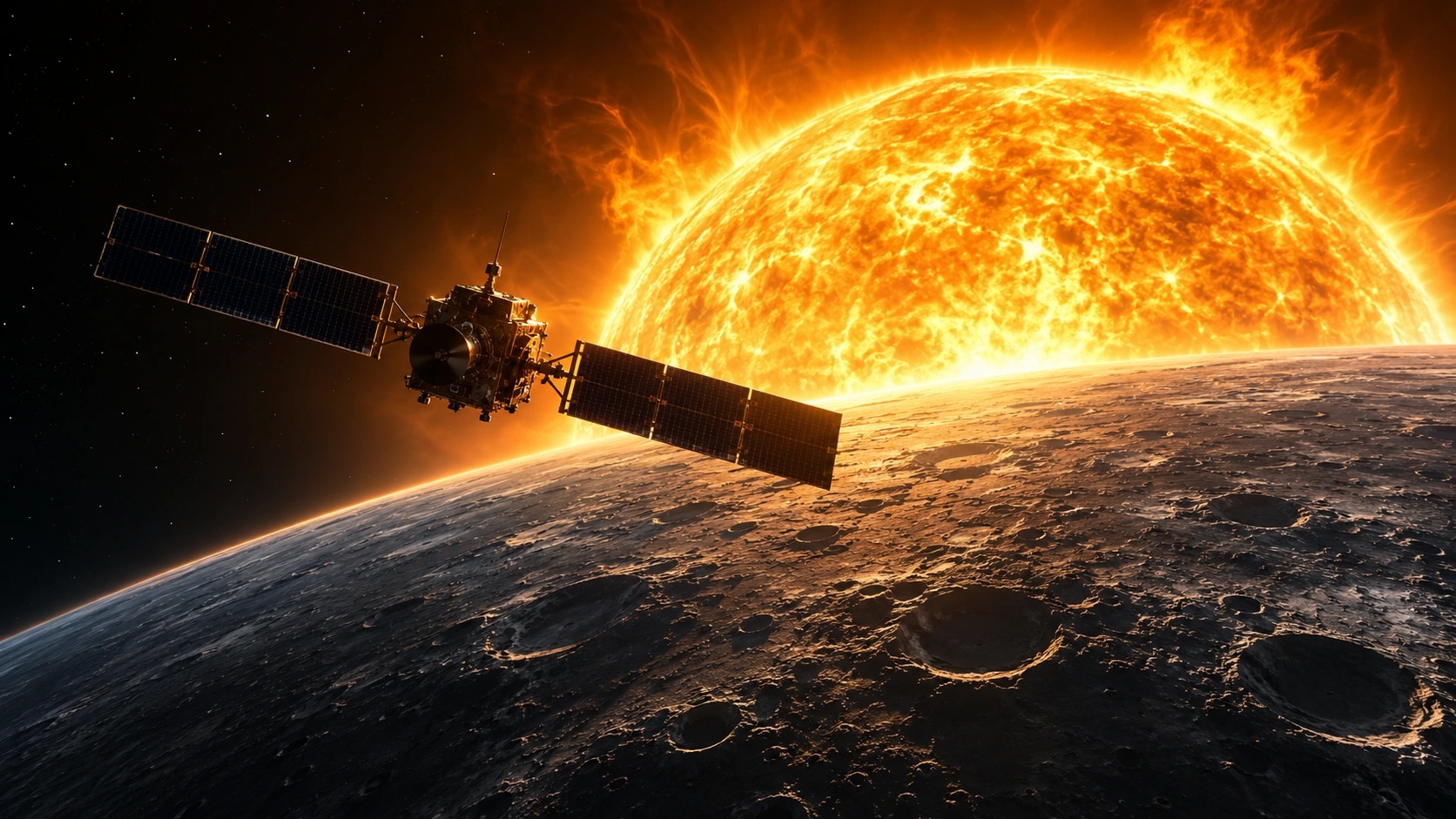
Because you can't just fly to Mercury; you have to slow down, and the Sun keeps speeding you up. The European Space Agency (ESA) says putting a spacecraft into a stable orbit around Mercury takes even more energy than sending a mission to Pluto. BepiColombo launched in October 2018 and entered Mercury orbit on November 21, 2026.
What happened on Nov. 21
BepiColombo is a joint mission of ESA and Japan's space agency, JAXA. ESA confirmed the capture on November 21. Four thrusters slowed the craft as it approached Mercury's south pole, placing it in an elongated 590 by 11,640 km orbit. Two orbiters ride together: ESA's MPO will study the planet, JAXA's Mio its magnetic field. They separate December 9–10, and science starts in April 2027.
Falling toward the Sun is the problem
Anything heading toward the Sun speeds up, like a sled on a long hill. Arrive at the bottom too fast and Mercury can't catch you; you sail past. Braking with engines would take enormous amounts of fuel. BepiColombo launched at 4,100 kg, 1,400 kg of it propellant, not nearly enough for a direct brake.
Nine flybys as free brakes
A gravity assist is a pass near a planet whose pull changes a spacecraft's speed and direction without fuel. Done right, it works as a brake. BepiColombo made nine, per ESA:
| Planet | Flybys | When |
|---|---|---|
| Earth | 1 | April 2020 |
| Venus | 2 | Oct. 2020, Aug. 2021 |
| Mercury | 6 | Oct. 2021 to Jan. 2025 |
Each one nudged the orbit closer to Mercury's, and waiting for the planets to line up added up to eight years.
How it compares
| Mission | Goal | Launch | Arrival |
|---|---|---|---|
| MESSENGER (NASA) | Mercury orbit | 2004 | 2011 |
| New Horizons (NASA) | Pluto flyby | 2006 | 2015 |
| BepiColombo (ESA/JAXA) | Mercury orbit | 2018 | 2026 |
New Horizons took more than nine years to reach a far more distant world, but it never slowed down; it flew past. MESSENGER needed six gravity assists before orbiting Mercury from 2011 to 2015. BepiColombo is only the third mission to Mercury and the second to orbit it.
Why go at all
ESA calls Mercury the least explored planet in the inner Solar System. Two orbiters watching the surface and the magnetic field at once can show how planets form close to stars, including around other suns. For more space news this month, see how NASA's Swift telescope is falling back to Earth.
Our view: in space, distance says little about difficulty. What matters is how much speed you must gain or lose, which is why a near planet can take longer than a far one.