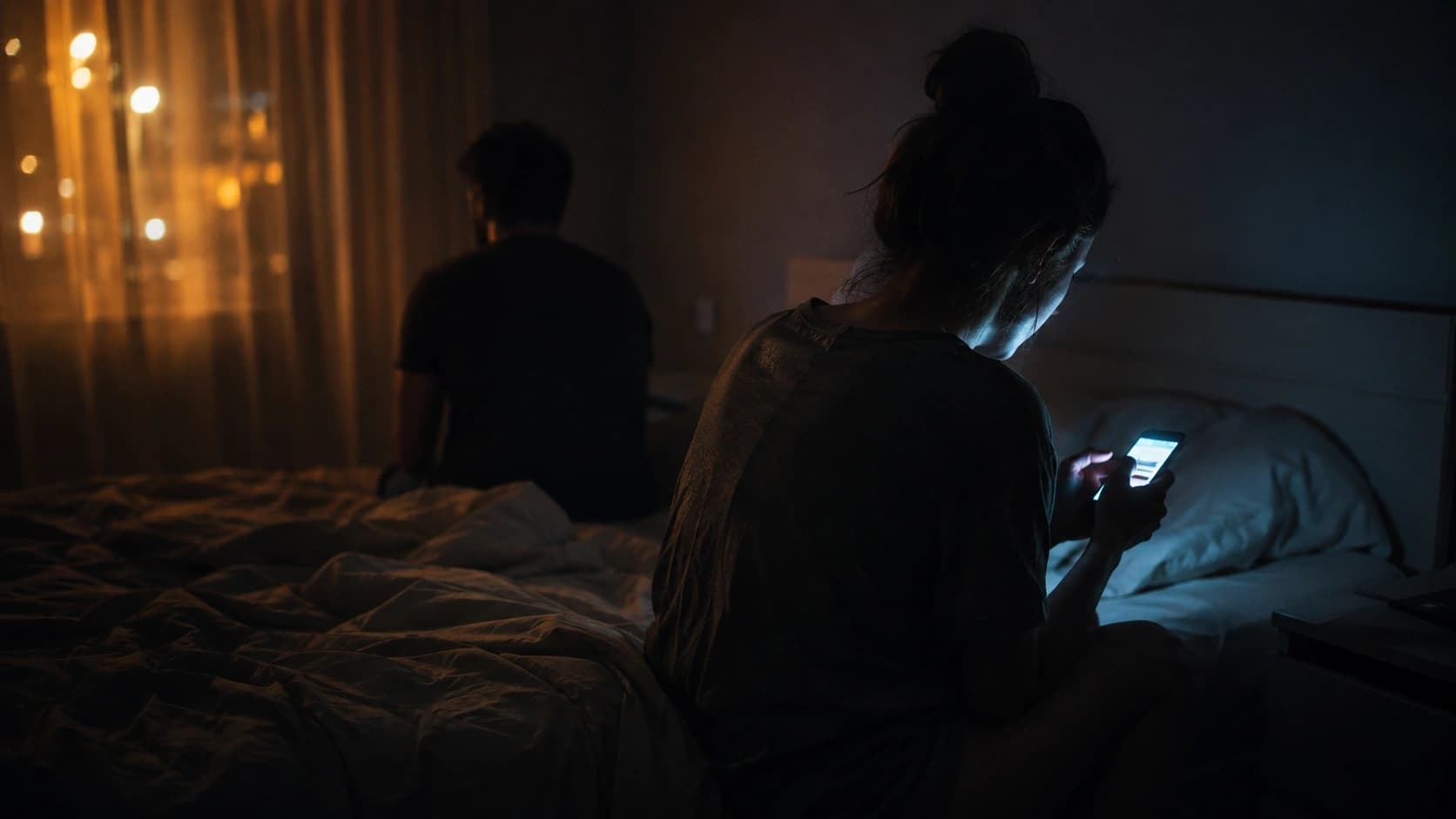
A couple is watching a show one evening. One partner is scrolling their phone under the blanket, assuming the other has already fallen asleep. A familiar scene, and the question behind it is harder than it looks: does porn actually damage relationships, or is that just moral panic without evidence?
The short answer: there is a real link, but it is more complicated than "porn ruins everything." And the most surprising part of the data is not about frequency at all, but about whether people watch together or in secret, more on that later. Here is what the actual research shows, not the headlines built on top of it.
What researchers found about relationship stability
The largest study on this to date came from Brigham Young University in the US, published in the peer-reviewed Journal of Sex Research (peer-reviewed means independent scientists checked the work for errors before it was published, unlike a blog post or a news article). Researchers surveyed more than 3,500 people in committed relationships about their porn habits and how stable they felt their relationship was.
The finding: the more often someone watched porn, the lower they rated their relationship's stability, and this held for both men and women. When both partners reported daily porn use, they rated relationship stability 45% lower and commitment 30% lower than couples who reported no porn use at all.
There is a catch the study itself states openly: this is an observational study, meaning it shows a correlation rather than proving that porn itself is what breaks a relationship down. The reverse is also plausible. People already in weaker, less satisfying relationships may turn to porn more often as a way to cope with a lack of closeness. Cause and effect could be running in both directions at once.
What about erectile dysfunction in young men
The science here is far more cautious than most popular articles suggest. An international study published in JMIR Public Health and Surveillance in 2021 surveyed 3,419 men aged 18-35, mostly from Belgium and Denmark.
Researchers used validated medical scales, standardized questionnaires doctors already trust for accuracy: one (CYPAT) to measure problematic, compulsive porn use, another (the IIEF-5) to measure erectile dysfunction. Some degree of erectile dysfunction showed up in 21.48% of sexually active participants. But the link was not to the fact of watching porn itself, it was specifically to problematic use: men with the lowest problematic-use scores had dysfunction rates of 12.9%, while men with the highest scores had rates of 34.5%.
One detail usually gets lost in the retelling. The authors themselves write that studies on the effect of porn-watching frequency on sexual function "have not come up with consistent associations," meaning other studies found conflicting results. Some studies of men under 30 found no association at all between porn use and erectile dysfunction. Claiming "porn causes impotence" as a settled fact is not honest to the science. The link is with compulsive, problematic use, not with the act of watching itself.
A study from Japan (Okabe, Takahashi, and Ito, 2021) shows a similarly cautious picture. Among 150 university students there, 97% of men and 35.9% of women used porn at least monthly, use that widespread is not, by itself, a problem. But 23.5% of participants showed impaired control over their viewing, and for 5.7% the difficulty was severe enough to interfere with daily life. It was specifically this narrower group with impaired control that showed higher anxiety, depression, and sexual compulsivity, not everyone who watches porn, just the people who cannot limit themselves.
Watching together is not the same as watching alone
This is where that difference shows up. A separate line of research looks not just at whether someone watches porn, but at the context: alone and hidden from a partner, or together as a couple. The difference turned out to matter: partners who watch porn together tend to report higher relationship quality than those who watch separately and keep it hidden from each other. It looks like the issue is less about porn itself and more about honesty, secrecy, and whether expectations inside the couple line up.
What this means in practice
Put all the findings together and the picture is not "porn equals harm." It is closer to "secrecy and misalignment inside a couple equals risk." A few practical consequences follow.
- Watching in secret, hidden from a partner, is linked to lower relationship quality more strongly than the fact of watching porn itself.
- Daily, compulsive use, the kind that starts to resemble a dependency rather than an occasional habit, is linked to both lower relationship stability and higher risk of erectile dysfunction.
- Talking with your partner about boundaries and expectations lowers the risk of conflict more effectively than avoiding the topic or imposing a ban.
- If you notice you cannot get aroused with a real partner without porn, that is a reason to see a sex therapist, not a reason to feel ashamed in silence. Problematic use responds to treatment.
Science does not yet hand down a final verdict of "porn destroys relationships" or "porn is harmless." It offers something more useful: what matters is not the act of watching, but whether it is hidden from your partner, and whether it has turned into a compulsion. So that partner under the blanket might not need to panic-close the phone, just turn over and say out loud what they are watching. Judging by the data, the difference between couples starts with that conversation, not with the screen.
Sources
- BYU News: Willoughby & Dover study, Journal of Sex Research
- PsyPost: methodology and limitations of the BYU study
- Jacobs T., Geysemans B., Van Hal G. et al. Associations Between Online Pornography Consumption and Sexual Dysfunction in Young Men. JMIR Public Health and Surveillance (2021)
- PsyPost: watching together vs. separately and relationship quality
- Associations Between Relationship Quality and Pornography Use Depend on Contextual Patterns of Use Within the Couple
- Okabe Y., Takahashi F., Ito D. Problematic Pornography Use in Japan: A Preliminary Study Among University Students (2021)