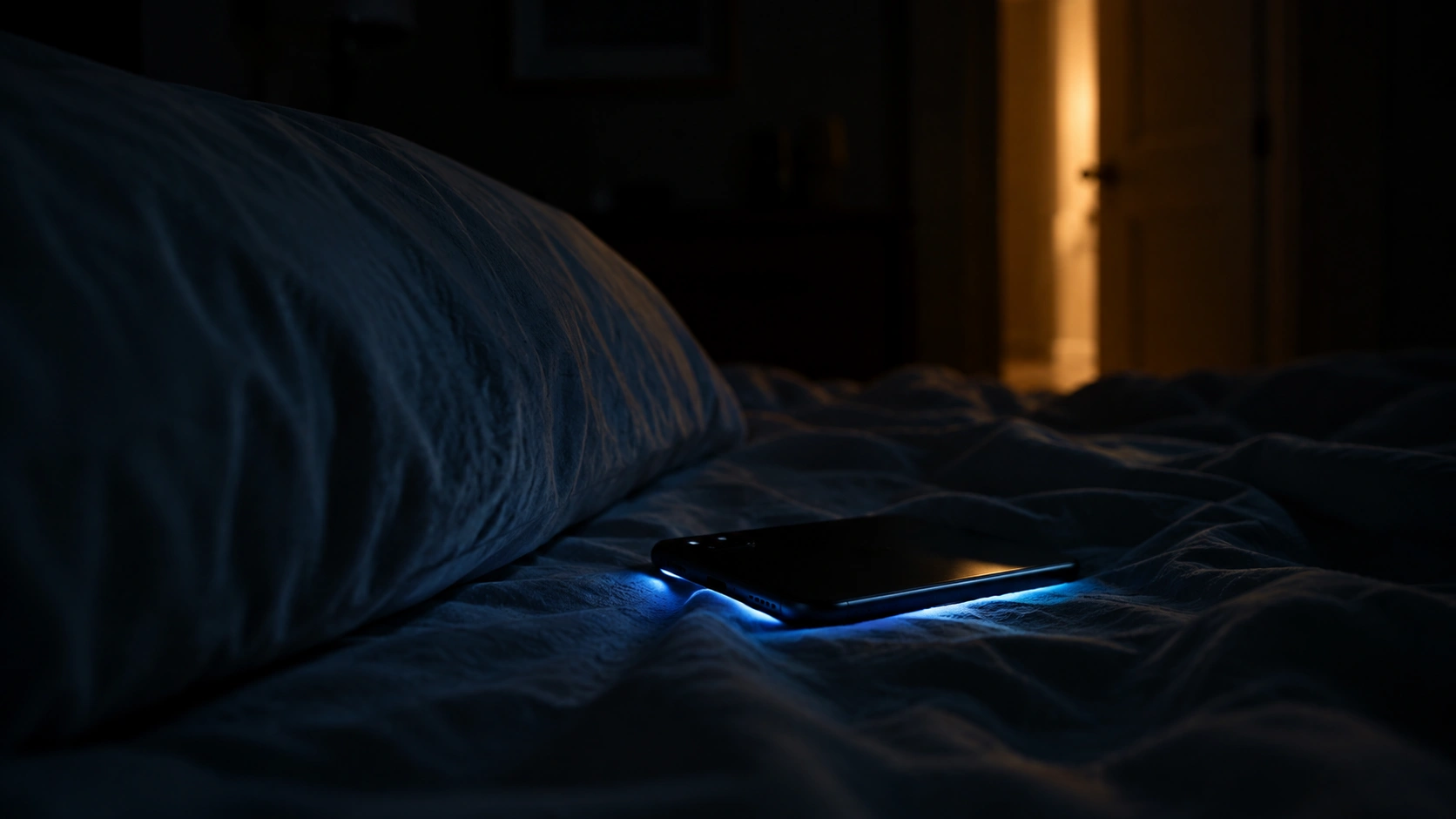
Every extra hour on your phone after you get into bed is linked to about 24 minutes less sleep and 59% higher odds of insomnia, according to a study of 45,202 students in Norway. The main thief isn't blue light. It's time: you go to sleep later and lie awake longer.
Midnight. Lights off, alarm set for seven. You open your feed "for five minutes", then check the clock and it's 12:40. Sound familiar? Here's what the research says, why it happens, and what to change tonight.
How much sleep do adults need, and how much do we get?
Adults need at least 7 hours of sleep a night, according to the American Academy of Sleep Medicine (AASM, the professional body for sleep doctors). Anything under seven counts as short sleep.
Plenty of people fall short. CDC data (the US Centers for Disease Control and Prevention) shows that in 2024 about 30.5% of US adults slept less than seven hours. Another 12.9% took something to fall asleep on most days: pills, supplements or CBD.
Countries differ a lot. OECD figures (the OECD is a club of roughly 40 developed economies), as reported by Nippon.com, give these daily sleep averages:
- China: 542 minutes (about 9 hours)
- United States: 528 minutes
- Spain: 516 minutes
- France: 513 minutes
- United Kingdom: 508 minutes
- South Korea: 471 minutes
- Japan: 442 minutes (about 7 hours 22 minutes, the lowest on the list)
These come from time-use diaries, which count all time in bed plus naps, so they run higher than the CDC numbers. They work for comparing countries, not for comparing with "30% sleep under seven hours". Where the missing minutes go is the part researchers have now pinned down.
What the Norwegian study found
Each extra hour of screen time after going to bed was linked to 59% higher odds of insomnia and 24 minutes less sleep. That's the finding of a 2025 study in Frontiers in Psychiatry.
A team led by Gunnhild Johnsen Hjetland surveyed 45,202 students aged 18 to 28, using data from Norway's 2022 national student health survey. People were asked how long they used screens once in bed, and what they were doing.
Insomnia here doesn't mean one bad night. It means frequent trouble falling asleep, waking in the night, or waking up unrefreshed.
One caveat matters: this is a cross-sectional survey (people were asked once, not followed over time). It shows a link, not a cause. Phones may disrupt sleep, or people who already sleep badly may scroll because they can't drop off. Probably both.
The more surprising finding is about what you're looking at.
Is social media worse than a show?
No: in the same study, the link between screen time and sleep barely changed with the activity. Social media, series, games or news all looked similar.
The authors' explanation is simple: displacement (one activity eating the time of another). Every half hour on your phone in bed is half an hour not spent sleeping. Think of a suitcase: pack something extra and there's no room for what you need.
Content still matters a little. A comment-section fight or alarming news at midnight wakes your brain more than a calm video. But if you change one thing first, change the minutes, not the apps.
What a study of 122,000 adults showed
Researchers at the American Cancer Society saw a similar pattern in more than 122,000 US adults, published in JAMA Network Open in 2025. They looked at screens in the last hour before sleep, excluding TV.
- About 41% used screens before bed every day; 17% never did.
- Daily users were 33% more likely to report poor sleep.
- They slept about 48 minutes less per week.
- The link was strongest in night owls (people naturally inclined to sleep and wake late).
48 minutes a week sounds small. Over two months it's almost a full night. And again, this is a survey, not an experiment.
So nobody has closed the case yet. Someone is trying to.
What about blue light?
Screen light can slightly delay melatonin (the hormone that tells your body it's time to sleep), but in the large surveys above it isn't the prime suspect. The US authors say it's still unclear whether light or content matters more.
The Norwegian data points to a third answer: time. That's why night mode helps less than people expect. It filters some blue light, but it doesn't give back the minutes you spent scrolling instead of sleeping.
A randomized trial in Sweden (participants are randomly split into groups, the most reliable way to test cause) now has one group stop screens 30 minutes before bed while the other lives as usual. Results aren't out yet. Until then, the honest takeaway is this: the link is strong and repeats across countries, and the simplest explanation is that the phone eats your sleep time.
How to win back those 24 minutes
Distance works better than willpower. By midnight everyone's willpower is spent, so change your setup instead of arguing with yourself.
- Charge your phone away from the bed. If you have to get up to reach it, you'll grab it less. A basic alarm clock costs less than lunch.
- Set a "last call" 30 to 60 minutes before sleep. That's the window Hjetland suggests. A reminder or your phone's Sleep mode makes it automatic.
- Pick what replaces the feed. Empty time gets refilled by the phone. A paper book, a shower, stretching or a chat with someone covers the same need to switch off.
- Awake for 20 minutes? Get up. Lying in the dark with your phone is worse than going to another room and coming back when you feel sleepy.
- Night owls benefit most. Their link between screens and poor sleep is strongest, so these steps pay off more.
For why the feed is so hard to put down in the first place, read why you can't stop scrolling. And if the clock change already threw you off, see how to fall back without losing sleep.
What to do tonight
One two-minute step: find a socket outside your bedroom right now (hallway, kitchen) and decide your phone sleeps there tonight. Set your alarm on a clock or an old offline phone.
Remember that midnight scroll "for five minutes"? Tonight, just don't start it. Tomorrow you get your 24 minutes back.