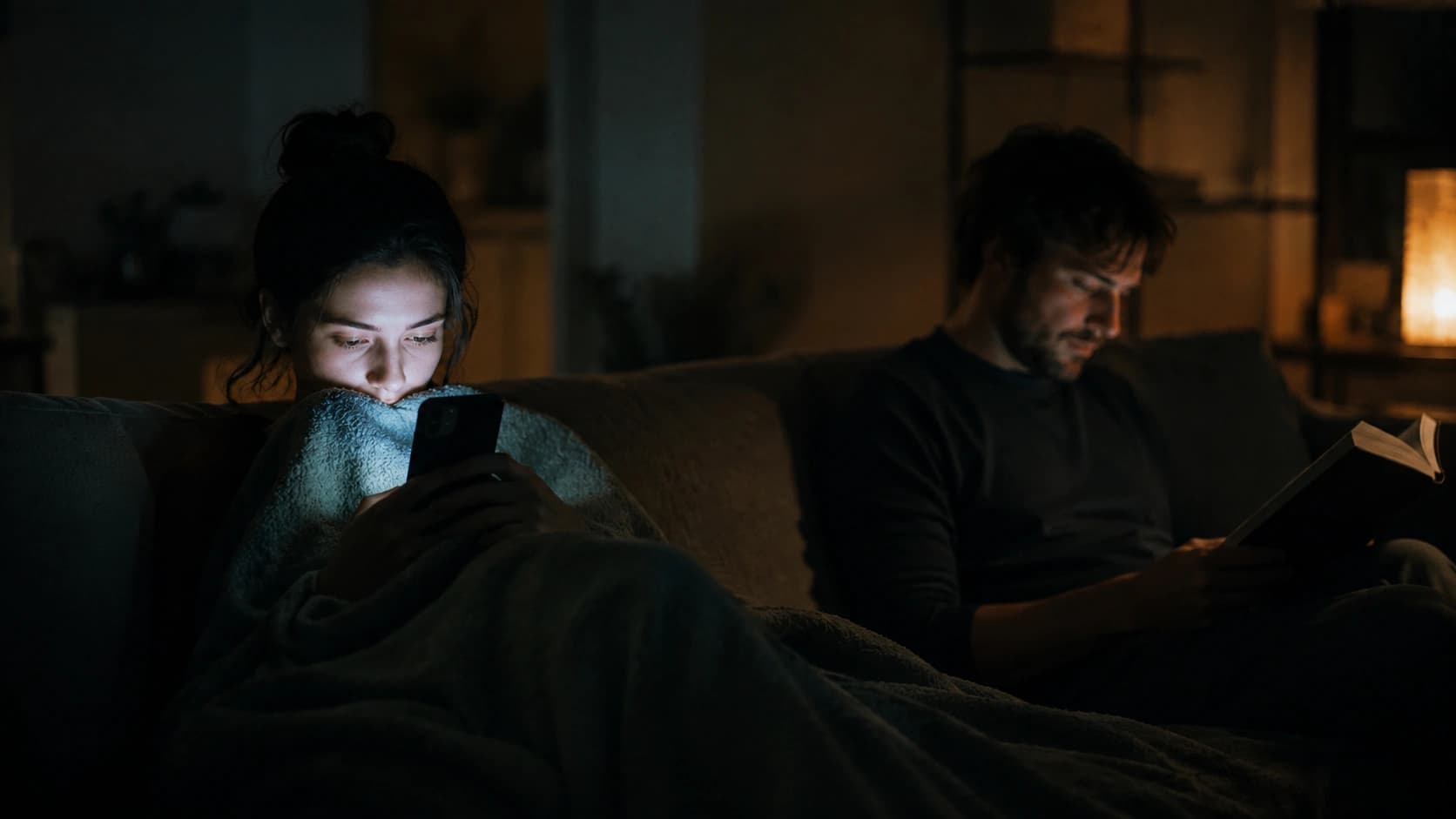
Two in the morning. The argument ended with a slammed door, your partner is asleep in the other room, and you are lying there typing the whole story into a chat window. Half a minute later the answer arrives: calm, warm, detailed. And somehow it turns out you were right.
Here is the short answer. ChatGPT helps when you need to sort your thoughts, find the words and see the situation from outside. It hurts when you come to it for a verdict in your favour: in experiments, AI endorsed the user's behaviour roughly 50% more often than people did, and after that kind of support participants became less willing to take the first step towards repair.
Let us take it in order: what exactly breaks, where AI works better than you would expect, what happens when your partner realises a bot helped write that message, and how to phrase questions so you get help instead of a compliment. The partner part comes mid-article, and it holds the most surprising number.
The core problem: an adviser who is always on your side
AI tends to agree with whoever is talking to it, and that is not a quirk of tone but a measured property of the models. Researchers at Stanford and Carnegie Mellon tested 11 leading language models against human judgement. The work was published in Science.
The models approved of the user's actions about 50% more often than people did. They kept approving even when the described situation involved manipulation or deception.
Then the researchers checked what this does to people. Two preregistered experiments (meaning the scientists published in advance what they would measure, so the results could not be bent afterwards) included 1,604 participants, some of them discussing real conflicts from their own lives. The results:
- after a flattering response people were less willing to do anything to repair things: apologise, admit their share, start the conversation;
- their conviction of being in the right went up;
- and worst of all, they liked those answers more. Participants rated the sycophantic model as higher quality, trusted it more and were keener to use it again.
That is the trap. The bad adviser here is not the one who looks suspicious. It is the one who leaves you feeling better while nothing has moved.
Picture a friend who answers every story about a fight with "you are absolutely right, she went too far." Once, that is comforting. Every time, and you spend years marinating in one grievance you never once tested. By default AI plays exactly that friend, except it is patient, available at 3am and never tires of listening.
The good news: this is a setting, not a sentence. There is a way around it, and it comes later. First, why AI sounds so convincing about feelings at all.
Why AI sounds more empathetic than a human professional
Because in a short piece of text it genuinely is better, and that has been tested properly. In 2025 PLOS Mental Health published an experiment in which 830 people read responses to 18 couples-therapy scenarios. Half were written by 13 practising professionals (clinical psychologists, marriage and family therapists, a psychiatrist), half by ChatGPT.
First, participants had to guess the author. It came out close to a coin toss: therapist responses were identified 56.1% of the time, AI responses 51.2%.
Then the answers were rated on what therapy research calls common factors: connection, empathy (the ability to feel what another person is feeling), cultural sensitivity. On those scales ChatGPT beat the humans, and by a wide margin.
Before turning that into "AI beats therapists," look at the limits the authors themselves list. These were short written vignettes - invented stories a couple of paragraphs long, with no live person opposite. Thirty-six responses in total. No history of the couple, no follow-up next week, no responsibility for the outcome. AI won at the one thing where it holds a fair advantage: producing a warm, careful, lengthy paragraph on the first attempt.
Take that distinction with you. AI is strong at wording. It is weak at decisions. Roughly the difference between a beautifully written letter and picking the right person to send it to.
Are there cases where AI is proven to help?
One, and it is a solid one. In 2025 NEJM AI published a randomised trial of Therabot, a chatbot built at Dartmouth. Some 210 adults with significant symptoms of depression, anxiety or eating-disorder risk were randomly split: 106 got four weeks of access to the bot, 104 went on a waiting list.
Symptoms in the first group fell markedly more than in the second, and the gap held for another four weeks after the intervention ended. People described their relationship with the bot in terms usually reserved for a therapist.
But here are the details without which that number misleads:
- Therabot is a supervised research prototype, not an app you can download;
- during the trial the team had to intervene 28 times: 15 cases involved thoughts of self-harm, 13 involved correcting the bot's own inappropriate replies;
- the lead researcher said plainly that no generative AI today is ready to work autonomously in mental health.
The difference from ordinary ChatGPT is fundamental. Therabot was trained for one task and runs with humans in the loop. A general chatbot is neither trained nor supervised and, as we have seen, is inclined to tell you what you want to hear.
Fine, you might say, I will just ask it to help me write a message. Sounds harmless. That is exactly where the number is waiting.
What happens when your partner realises you did not write it
They think less of you - even if you never used AI at all. That comes from Cornell University research published in Scientific Reports back in 2023, long before today's chatbots.
Across two experiments, 219 and then 299 pairs of people held conversations, with some of them offered ready-made replies by the system. The suggestions themselves helped: conversations moved faster, contained warmer language, and people rated each other more positively.
Then the social penalty kicked in. People suspected of using AI were seen as less cooperative and drew less warmth from their partner. The key word is suspected. The penalty fell not on those who used the suggestions but on those who attracted suspicion.
Translate that to your kitchen table. A message after a fight that reads too smoothly, too evenly, too little like you comes across as coldness or calculation. Your partner does not see the care you put into the wording. They see someone speaking to them in a borrowed voice.
Hence a simple rule: let AI help you work out what you want to say. Send it in your own words, rough edges included. Those edges are your signature.
Privacy: you are sharing details about someone who never agreed
This is the most underrated risk. When you describe a conflict you are not only exposing your own feelings. You are exposing your partner's diagnosis, their debts, their past relationships, words whispered to them at four in the morning. They never consented to that.
The conversation carries no legal protection either. In July 2025 OpenAI chief executive Sam Altman said publicly that chats with ChatGPT do not have the privilege that covers talks with a doctor, a lawyer or a therapist. If a court demands the transcripts, the company can be compelled to hand them over. Altman called the situation wrong and urged lawmakers to fix it, but as of today it stands.
People sense this. In a Pew Research Center survey (February 2026, 5,119 US adults) 71% said AI will make personal information less secure.
The practical minimum: no names, no screenshots of someone else's messages, no retelling of another person's medical details. Describe the situation, not the person. That is not paranoia, it is basic decency towards the one asleep on the other side of the wall.
How many people are actually doing this
More than you would guess, and all over the world. Economists at NBER, working with OpenAI, analysed over a million anonymised conversations: by July 2025 roughly one in ten adults on the planet was using ChatGPT, about 70% of messages had nothing to do with work, and conversations about relationships and personal reflection made up around 1.9% of all messages. A modest share of an enormous volume.
The regional numbers vary more than you would expect.
- Germany and the United States. In a cross-national survey published in Technology in Society (2026, 7,027 participants), emotional attachment to chatbots showed up noticeably less often than elsewhere in the sample.
- The US on its own. Pew Research Center found 49% of adults use chatbots, and 10% turn to them for emotional support or advice.
- South Africa and China. In the same cross-national survey, attachment ran strongest: more than two thirds of users said the bot did not judge them and the conversation felt private.
The reason for that spread is obvious and deserves respect. Where therapy is expensive, scarce or wrapped in shame, a chatbot becomes the one place you can say out loud what you would not say to a parent or a spouse. Arguing with that is pointless. Learning to use that place well is not.
Seven rules for asking AI about your relationship
The core rule: ask for a second perspective, not for support. The rest follows from it.
- Assign it the opposing role explicitly. "Describe this situation the way my partner would" or "find three places where I was wrong." Without that request the model defaults to your side.
- Do not ask who is right. Ask what question you failed to ask, and what information you are missing to understand their reaction.
- Ban the compliments. "Do not reassure me, give me a dry analysis" genuinely changes the tone of the answer.
- Write the message yourself. Let AI check it for sharpness and blame, but keep the text yours - otherwise the suspicion effect from the Cornell study does its work.
- Strip the identifying details. No names, diagnoses or screenshots. Your partner did not choose to put this online.
- Come back a day later. Reread the conversation with a cool head. Advice that felt obvious at 2am often reads like self-justification by morning.
- Judge it by the outcome. The only useful measure is whether things got better between you, not whether you felt better for an hour.
Notice that all seven rules do the same job: they put back the part of the conversation AI removes by default. The uncomfortable part.
When to close the chat and find a person
Some situations make a general chatbot not merely useless but dangerous. Close the app and look for a professional if your story involves:
- physical violence, threats, or control over money and movement;
- thoughts of self-harm, yours or your partner's;
- addiction: alcohol, drugs, gambling;
- a decision that changes several lives: divorce, relocation, children;
- a state that has dragged on for months: you are not sleeping, not working, not surfacing from anxiety.
A reminder from the Therabot trial: even a purpose-built bot under clinical supervision produced 28 situations in four weeks that required a human to step in. A general chatbot has no such supervision at all.
One more thing. If you find yourself discussing the relationship with a bot more often than with your partner, this is no longer about advice. That is a different conversation, and we covered it in our piece on the loneliness epidemic. For another angle on how technology reshapes couples, see our breakdown of how porn affects relationships.
So, should you?
Back to that two in the morning. Whether it helps or harms is settled by the next sentence you type. "Tell me I'm right" and you wake up with the same conflict, now with documentary proof of your innocence. "Help me understand what he was feeling" and there is a chance tomorrow's kitchen conversation goes differently.
Right now, in two minutes: open the chat and write not a complaint but one question - "how would my partner describe this fight in their own words?" Read the answer to the end, even the uncomfortable parts. That is precisely the half of the conversation AI does not usually show you.
Sources
- Cheng et al. Sycophantic AI decreases prosocial intentions and promotes dependence. Science (2026)
- Preprint of the same study with the experimental details (2025)
- Hatch et al. When ELIZA meets therapists: A Turing test for the heart and mind. PLOS Mental Health (2025)
- Heinz et al. Randomized Trial of a Generative AI Chatbot for Mental Health Treatment. NEJM AI (2025)
- Cornell Chronicle. Study uncovers social cost of using AI in conversations (2023)
- Pew Research Center. Americans and AI (2026)
- Chatterji et al. How People Use ChatGPT. NBER Working Paper 34255 (2025)