Not investment advice. This article is for informational purposes only. Past performance does not guarantee future results. Consult an independent financial advisor before making financial decisions.
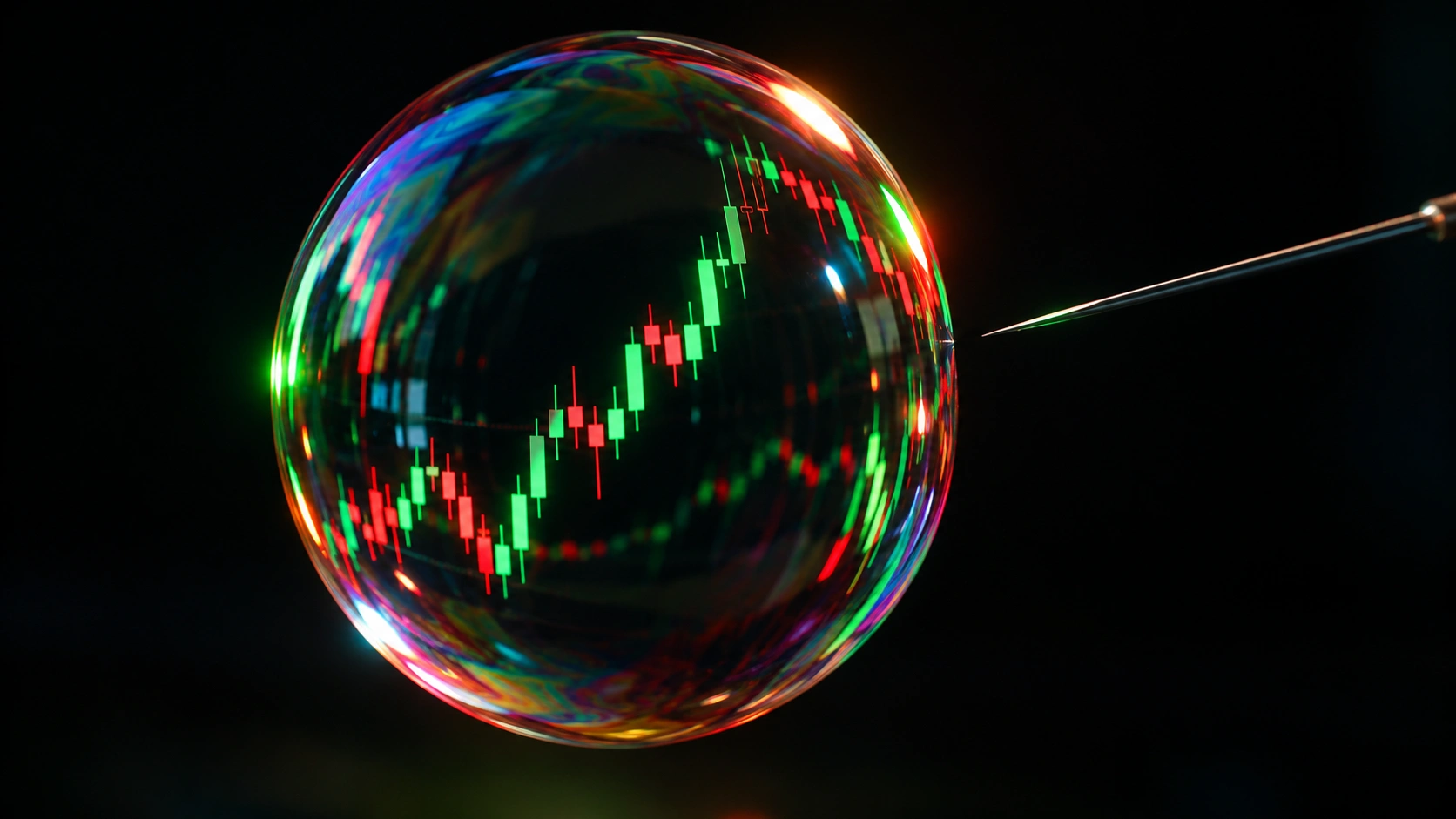
You open your brokerage or retirement app and see a nice gain for the year. Feels good. But in October 2026 the International Monetary Fund (IMF) named a sharp drop in AI stocks as one of the top risks to the global financial system. If the AI bubble bursts, it won't just hit tech giants. It will hit ordinary people whose savings sit in funds tracking US stocks. Here is what a bubble is, why everyone is talking about it now and what's sensible to do today.
A caveat up front: nobody knows if or when it will burst. Most analysts still expect gains. But there is one number that didn't exist even in 2000, and we'll get to it halfway through.
What is a market bubble?
A bubble is when stock prices rise much faster than companies' real earnings, because people buy on hopes of future growth rather than today's profits. While everyone believes, prices climb. When belief fades, prices fall fast, because everyone sells at once.
Think of an apartment that gets resold every month for more, even though nothing about it changes. Each buyer hopes to sell to the next one for even more. It works as long as new buyers show up. When they stop, the price falls back to what the place is really worth.
The classic example is the dot-com crash. The Nasdaq (a stock index made up mostly of tech companies) lost about 74% from March 2000 to October 2002, including dividends. On price alone, it didn't get back to its old high until February 2015, almost 15 years later.
So why does that story keep coming up now?
Why the AI bubble talk is happening now
Because the market has never relied this heavily on a handful of companies. The "Magnificent Seven" (Apple, Microsoft, Nvidia, Alphabet, Amazon, Meta and Tesla), nearly all big AI bets, made up about 35% of the S&P 500 (the 500 largest US companies) in early June 2026. According to a CME Group piece, that's a record for the index. The previous high, about 26%, came in 1980 and in March 2000, right at the dot-com peak.
That's the number that didn't exist in 2000. Ten years ago the seven were about 12% of the index. Now it's three times that. Put simply, a third of the money in the world's most popular index rides on one story: faith in AI.
On October 13, 2026, the IMF's financial stability report named a fall in AI stocks as one of three "salient risks" that could sharply tighten financial conditions (meaning loans get pricier and harder to get worldwide). The other two: rising government borrowing costs and a major cyberattack.
"We now have an economy that is standing on one leg, the AI leg."
- Kristalina Georgieva, IMF Managing Director, Oct. 13, 2026, Reuters via BusinessDay
Concentration alone doesn't make a bubble, though. What worries the IMF more is where the money comes from.
Why AI money moves in circles
The IMF singled out "circular financing": big companies invest in smaller partners, and those partners use the same money to buy chips and cloud capacity from the big companies. Both report higher revenue, but much of the money just goes round in a loop.
Everyday version: you lend a friend money, and they immediately use it to buy your old bike. You record a "sale", but nobody got richer.
The scale, per the IMF as reported by The Guardian:
- about $300 billion of such deals over three years between the largest cloud companies and weaker AI firms;
- topped up with about $650 billion of debt in exchange for $1.4 trillion in future commitments;
- three sources of borrowed money worry the IMF: debt taken on by AI companies, bets by hedge funds (aggressive funds for large investors) and individual investors borrowing to buy AI stocks.
Debt is a magnifying glass. On the way up it multiplies gains; on the way down it multiplies losses and forces quick selling. That's how a small dip turns into a crash.
How far could the market fall?
Forecasts vary widely, and both sides deserve a fair hearing.
- The bear case. Joachim Klement, a strategist at London bank Panmure Liberum, expects the S&P 500 to fall to 5,000 by the end of 2027, a 36% drop. He argues the biggest cloud companies have nearly used up their spare cash and increasingly rely on debt. He told Bloomberg he believes the AI bubble will burst in 2027 or 2028 (Oct. 8, 2026, as reported by Bloomberg Línea).
- Most disagree. His was the gloomiest of eight forecasts Bloomberg reviewed. On average, strategists expected a 14% gain.
- The economic hit. In the IMF's downside scenario, a steep cut in AI investment would lower global GDP (the size of the whole economy) by 1.1% by 2028, and US output by 1.8%.
The IMF itself stresses this is about vulnerability, not a forecast of a crash. A bubble can also deflate slowly instead of popping.
Editor's view: no one can time a crash, including the authors of the loudest predictions. But record concentration and growing debt are facts, not opinions. So the useful question isn't "will it burst?" but "how much of my money depends on one story?"
What this means for ordinary savers
Even if you've never bought a single Nvidia share, you may be more tied to AI than you think. The most popular way to save, an S&P 500 index fund, is now roughly one-third Magnificent Seven. The same goes for many retirement plans invested in US stocks.
According to Athanasios Vamvakidis, a deputy director at the IMF, the rest of the world's exposure to US assets, especially AI, is the highest it has ever been. The IMF sees Britain and the euro area as better insulated than Asia, but anyone holding US stocks would feel a drop.
Picture two savers. Anna, 32, puts part of every paycheck into an S&P 500 fund for a home down payment in three years. If the market falls a third right before she buys, she has to wait or sell cheap. Mark, 25, is saving for retirement 35 years away. The same drop hurts him far less: he has time to ride it out.
What's sensible to do now
This isn't investment advice. It's a set of questions to ask yourself:
- When will you need this money? If it's within 2-3 years (a home, school, a wedding), keeping it all in stocks is risky in any market.
- How much rides on one story? Look up what your fund or portfolio holds and how much is in tech.
- Do you have an emergency fund? A few months of expenses kept somewhere safe means you won't have to sell stocks at the worst moment.
- Don't borrow to buy stocks. That's exactly what the IMF flags as a key risk.
- Don't panic-sell everything. Someone who invested at the dot-com peak in December 1999 and held on still earned about 8% a year over the next 25 years with dividends, according to The Motley Fool.
For how to build savings that don't depend on a single market, see how to build future income.
Back to that app. Open it today and find one line: what share of your money is in tech companies. Five minutes is enough. That number says more about your risk than any forecast.
Sources
- IMF Global Financial Stability Report, Oct. 13, 2026 (as reported by The Guardian)
- Reuters: IMF warns of risks from AI market correction (Oct. 13, 2026)
- Bloomberg Línea: Panmure Liberum forecast (Oct. 8, 2026)
- CME Group / Institutional Investor: S&P 500 concentration (Sept. 7, 2026)
- DQYDJ: Nasdaq drawdown history
- The Motley Fool: returns from the dot-com peak (2025)