For informational purposes only. This article does not replace professional medical advice and is not intended for self-diagnosis or self-treatment. Consult a qualified healthcare provider before making health-related decisions.
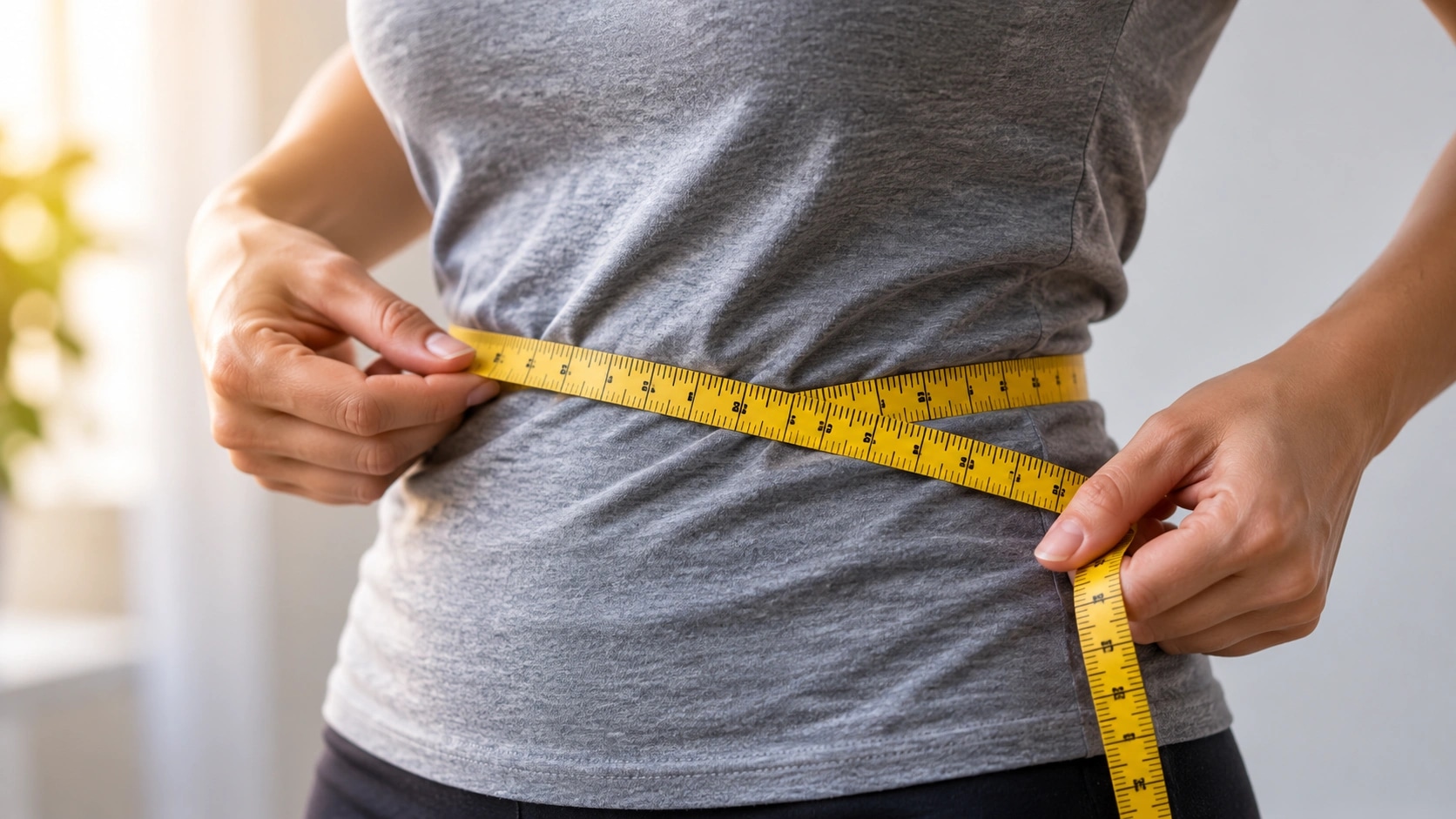
Measure your waist halfway between your lowest rib and the top of your hip bone, after a normal breath out. Divide that number by your height in the same units. Under 0.5 is a healthy range; 0.5 to 0.59 means increased health risk; 0.6 or more means further increased risk. Those are the bands in the UK clinical guideline NICE NG246.
In January 2025 a 58-member commission convened by The Lancet Diabetes & Endocrinology recommended that obesity should not be diagnosed from body mass index (BMI, weight in kilograms divided by height in meters squared) alone. Excess fat should be confirmed by direct measurement or at least one body measurement such as waist size, waist-to-hip ratio or waist-to-height ratio.
What BMI can't see
BMI knows your mass, not where it sits. A muscular person can have a BMI of 31 with little fat, while someone at 24 can carry fat deep around the abdominal organs, the kind most closely tied to type 2 diabetes, high blood pressure and heart disease. NICE itself says BMI should be interpreted with caution because it does not measure central fat.
A Nature study published November 11, 2026, covering 844,108 adults in China, the UK, the US and Spain, found that BMI alone missed obesity in 5.2-8.6% of people and wrongly flagged 1.2-3.1%. We covered it in BMI misses the point: only a third with obesity are ill.
Step by step
- Stand straight, feet together, arms by your sides, light clothing.
- Find the bottom of your last rib and the top of your hip bone on your side.
- Wrap the tape midway between them. NICE notes this is usually just above the belly button.
- Keep it snug but not tight, and don't suck in.
- Breathe out normally, then read the number.
- Measure twice. If the two are within 1 cm (about half an inch), average them; if not, repeat both.
The WHO expert consultation report recommends this midpoint site and notes that studies use non-stretch tape with constant tension. At home, use the same tape at the same spot each time so your readings stay comparable.
The math, and a chart by height
Divide waist by height: NICE's own example is 38 inches ÷ 67 inches (5 ft 7 in) = 0.57. The 0.5 line is simply half your height:
- 5 ft 0 in (60 in): keep your waist under 30 in;
- 5 ft 4 in (64 in): under 32 in;
- 5 ft 8 in (68 in): under 34 in;
- 6 ft 0 in (72 in): under 36 in;
- 6 ft 4 in (76 in): under 38 in.
NICE applies the same bands to adults of both sexes and all ethnicities with a BMI below 35, including people with high muscle mass. Its advice to clinicians is to tell people to keep their waist to "less than half their height."
Why not just use waist size?
Fixed waist cut-offs ignore height. The figures often quoted as WHO norms, over 94 cm (37 in) for men and 80 cm (31.5 in) for women for increased risk, come from a Dutch sample of 2,183 men and 2,698 women, and the WHO report notes they were originally offered as an example, not an official recommendation. The International Diabetes Federation uses 90 cm for South Asian, Chinese and Japanese men.
With a fixed 94 cm cut-off, a 6 ft 3 in man is "fine" at a ratio of 0.49, while a 5 ft 5 in man with the same waist is at 0.57. A 2012 meta-analysis by Margaret Ashwell and colleagues in Obesity Reviews, pooling 31 papers and more than 300,000 adults, found waist-to-height ratio identified diabetes, hypertension and heart disease better than either waist size or BMI. That was a comparison of screening accuracy, not proof that shrinking your waist adds years.
What the number won't tell you
A ratio above 0.5 shows excess central fat, not disease. Under the Lancet framework, a doctor then checks organ function: blood pressure, blood sugar, liver, joints, breathing during sleep. In the Nature cohorts, 77.4-91.3% of people with preclinical obesity did not develop clinical obesity over ten years. These are observational data: they show association, not cause. The adult bands don't apply to children or to people with a BMI of 35 and above.
Editor's view: this is the cheapest home check backed by a clinical guideline and a large evidence base. A reading above 0.5 is a reason to get blood work and a blood pressure check, not a reason for a crash diet. Write the number down with today's date, and measure again in six months.