Clothes you drop into a donation bin almost never become new clothes. According to the Ellen MacArthur Foundation, less than 1% of the material used to make clothing is recycled into new clothing. The rest is sold abroad by weight, shredded into rags (cleaning cloths for factories and garages), burned, or dumped. Sometimes tens of thousands of kilometers from where it was handed in.
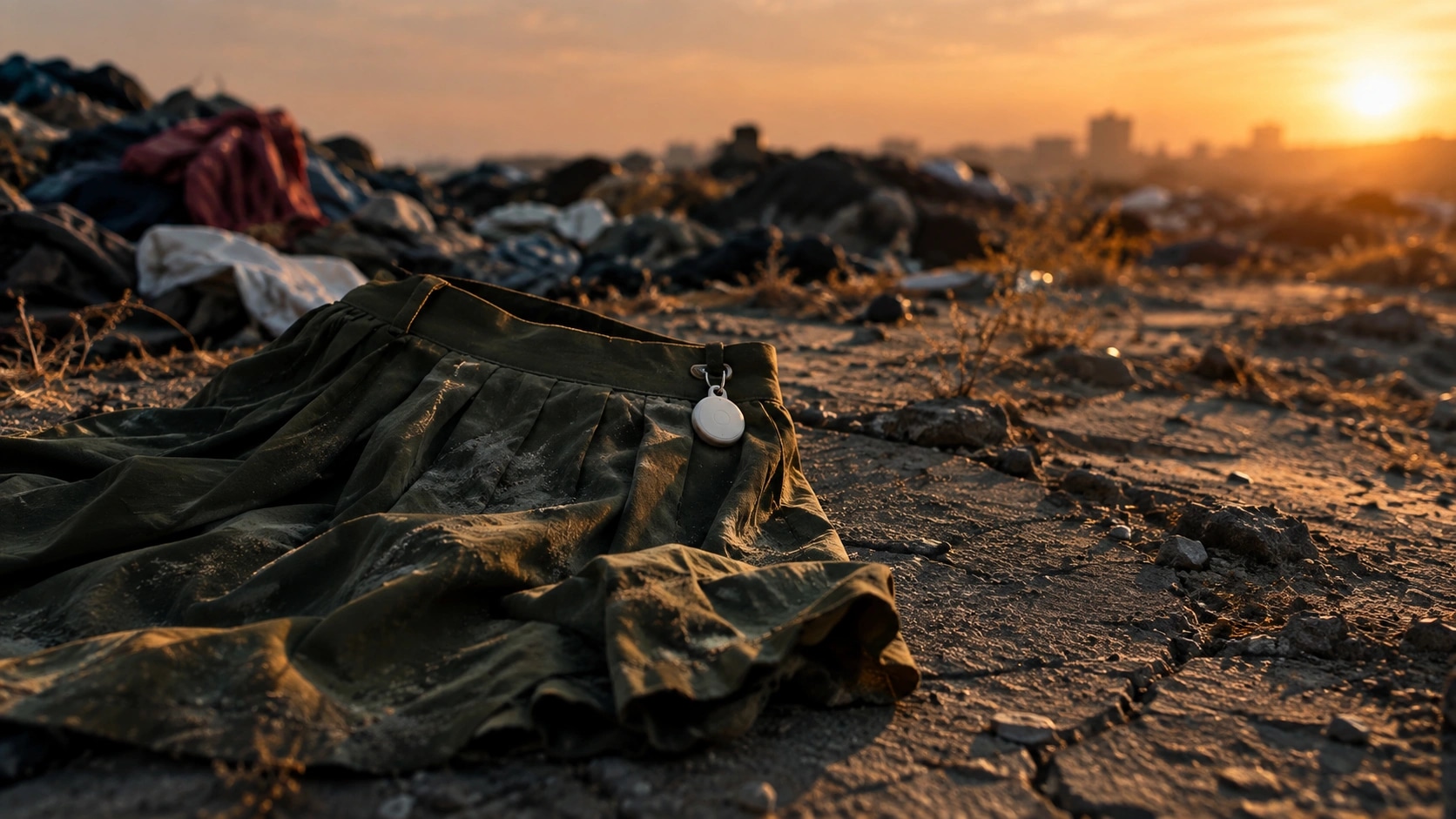
An olive green skirt was returned to an H&M store in London. Attached to it was an AirTag (a small Apple tracker that shows where an object is). The signal passed through the United Arab Emirates and stopped in Bamako, the capital of Mali. On a vacant lot. The skirt traveled 24,800 kilometers to end up somewhere it was, by every sign, simply thrown away.
It wasn't a one-off. It was part of an investigation that tracked 21 items for a year. Below: what happened to the rest, where donated clothes end up across Europe, the US, Africa, Asia and Central Asia, and what you can actually do about it. The most surprising finding is about a factory that was supposed to fix the whole problem. More on that near the end.
What the AirTag experiment found
Three out of four good-quality items handed in at fashion brands' collection points never found a new owner. The experiment was run by the Changing Markets Foundation (a European nonprofit that checks companies' environmental promises), together with Zero Waste France and Zero Waste Alliance Ukraine.
Between August 2022 and July 2023, researchers handed in 21 items in excellent condition: coats, trousers, jackets. They took them to H&M, Zara, C&A, Primark, Nike, The North Face, Uniqlo and M&S stores in Belgium, France, Germany and the UK, and mailed some to a Boohoo scheme. These are called take-back schemes (a store accepts your old clothes, often in exchange for a discount). Brands present them as a step toward recycling.
Here's what the trackers showed:
- 16 of 21 items (76%) were destroyed, left in warehouses or shipped to Africa.
- Trousers handed in at M&S were scrapped within a week.
- Trousers from a C&A store in Germany traveled 464 km and were burned in a cement kiln.
- A Primark hoodie traveled 2,346 km around the UK and ended up in a skip.
- A Zara puffer jacket went 2,224 km to Lithuania and got stuck in a warehouse.
- Three items ended up in Ukraine, four went to Africa.
- Only 5 items found a second life. They were resold in Europe.
Why a cement plant? Cement kilns often burn waste in place of some of their fuel. Reports call this "energy recovery." For a coat in excellent condition, it's simply the end of the road.
A fair caveat: 21 items is a small sample. It's not industry-wide statistics, more like a snapshot of a single day. But much bigger numbers, collected in completely different ways, show the same picture. And they're bigger in every sense.
How much clothing actually gets recycled?
Almost none of it becomes new clothing. The most cited estimate comes from the Ellen MacArthur Foundation (a UK charity that studies the circular economy, where things are reused instead of thrown away). In its 2017 report "A New Textiles Economy," the foundation traced what happens to all the material used to make clothing worldwide:
- 73% is burned or landfilled after use;
- 12% is recycled into something simpler: insulation, wiping cloths, mattress stuffing;
- less than 1% becomes new clothing.
The foundation put it in a single image: every second, one garbage truck's worth of textiles is burned or buried in a landfill.
That middle category is called downcycling (turning something into a lower-value product than it was). A sweater doesn't become a sweater. It becomes wall insulation. That's better than a landfill. But it's not the neat loop of arrows printed on the label.
The report is almost ten years old, and newer data isn't better. According to the European Environment Agency (EEA, 2025), people in the EU generated 6.94 million tonnes of textile waste in 2022, about 16 kg per person. Less than 15% was collected separately. The rest went into regular trash along with packaging and food scraps.
The US looks similar. The Environmental Protection Agency (EPA) estimates that Americans threw away 17 million tons of textiles in 2018, the latest year with a detailed breakdown. The recycling rate was 14.7% for all textiles and 13% for clothing and footwear. 11.3 million tons went to landfills, and another 3.2 million tons were burned for energy.
Why clothes are so hard to recycle
The problem is what they're made of. Most garments are blends: cotton with polyester, wool with acrylic, plus dyes, zippers, buttons and patches. Separating that back into clean materials is a bit like getting the sugar back out of a baked cake. Possible in theory, but expensive and hard.
The simplest method is mechanical: the fabric is cut up and combed back into fiber. But the fibers tear and get shorter in the process. Short fibers make a coarser, weaker thread than the original. That's why recycled yarn tends to become blankets, rugs and rags, not a new T-shirt.
Synthetics are a problem of their own. According to Changing Markets (2023), synthetic fibers make up 69% of all fiber produced worldwide. Polyester is plastic. A polyester garment that gets thrown away behaves like plastic: it doesn't rot for years and slowly breaks down into microfibers. For what that means for your health, see are microplastics harmful: what is proven and what is hype.
If almost nothing becomes new clothing and landfills at home are full, where does the rest go? Most of it travels to places where labor is cheaper and oversight is weaker.
Where unsold clothes are shipped
Clothes that can't be sold locally are exported, mostly to Africa and Asia. They're pressed into bales (tightly packed bundles wrapped with straps) and sold by weight.
The European Environment Agency found (2023) that used textile exports from the EU tripled, from 550,000 tonnes in 2000 to almost 1.7 million tonnes in 2019. Here's where they went:
- 46% to Africa. European clothing is cheaper than new clothes there and goes to local markets. What can't be worn, the agency says, mostly ends up in open dumps and informal waste streams.
- 41% to Asia. There, items are sorted in special economic zones, turned into industrial rags and stuffing, or shipped onward: for recycling elsewhere in Asia or for resale in Africa.
The top destinations in 2019 were Pakistan and the United Arab Emirates. The UAE is a transit hub with sorting centers that send clothing all over the world. The skirt from the start of this article took exactly that route. From London to a SOEX sorting facility in the UAE, then on to Mali.
So what happens when a bale reaches Africa? One market in Ghana shows it best.
Kantamanto: the market that gets 15 million items a week
Kantamanto in Accra, Ghana's capital, is one of the largest second-hand clothing markets in the world. The Or Foundation (a nonprofit that works with the market's traders) estimates it receives about 15 million garments every week. Traders spend around $325 million a year on bales.
Every bale is a gamble. You only find out what's inside after you pay: jeans that will sell in a day, or clothes nobody wants. Traders in Kenya told Changing Markets researchers that 20 to 50% of the items in a bale they buy can't be sold.
Bales weighing around 55 kg are carried through the market on the heads of porters called kayayei. According to The Or Foundation, this grueling and sometimes deadly work is done even by girls as young as nine.
Whatever doesn't sell becomes waste. The Or Foundation estimates that about 40% of an average bale leaves the market as waste. It piles up in the Old Fadama settlement and along Accra's coastline.
So is it 40% or 4%?
This is where the story turns. In May 2024, the Ghana Used Clothing Dealers Association published its own study: by its count, less than 5% of imported clothing counts as waste. That looks like a flat rebuttal.
But the two numbers measure different things. The Or Foundation's own 2022 study also found that about 4% of a bale is waste on arrival. The 40% is what traders never managed to sell and what eventually leaves the market as trash. The first number is about bale quality going in. The second is about what's left coming out, after weeks of trying to sell it.
That leads to an uncomfortable conclusion. The problem isn't just "trash disguised as clothing." It's volume: more clothes arrive than there are people to buy them.
Kenya shows a similar picture, with plastic on top. According to the Changing Markets report "Trashion" (2023), more than 900 million used garments were shipped to Kenya from around the world in 2021, 112 million of them directly from the EU. Up to 458 million may have been waste, and up to 307 million of those contain synthetic, meaning plastic, fibers. The worst items, locally called "fagia," get dumped in the Nairobi River or burned as fuel, for example to roast peanuts.
Africa isn't the only end of the line. On the other side of the world, the clothes reach a desert.
The Atacama: the desert where fashion ends
In Chile, clothing from all over the world ends up in one of the driest deserts on the planet. According to AFP (2021), about 59,000 tonnes of used clothing arrive every year at the free trade zone of the port of Iquique (an area where goods can be imported without duties). Some is bought by merchants from Santiago, some is smuggled to neighboring countries. And about 39,000 tonnes that nobody buys end up in dumps in the Atacama Desert, near the city of Alto Hospicio.
A garment there can have three continents in its life story. According to AFP, the clothes are made in China and Bangladesh, worn in Europe, Asia or the US, and only then shipped to Chile.
National Geographic describes the local La Quebradilla market: more than 7,000 stalls, bales weighing about 600 kg selling for around $20, and single items going for 12 cents to $2.
Synthetic fabric barely breaks down in the desert: according to an estimate cited by AFP, it takes about 200 years. The piles catch fire from time to time, sending black, toxic smoke over the city.
Why not ban it? Since 2016, Chile has had an extended producer responsibility law, Ley REP (a rule that whoever sells a product pays for collecting and recycling it). But at the time of National Geographic's report, textiles weren't covered: the law applied to six other types of waste.
So far it sounds like recycling doesn't exist at all. That's not true. It does exist, it just looks nothing like the picture with the green arrows.
Panipat: where old sweaters become blankets
Large-scale clothing recycling does exist, and one of its centers is the Indian city of Panipat. According to Atmos, it processes more than half a million tons of used clothing a year. The clothes arrive from US and European donation bins through the ports of Kandla and Mundra.
Here the clothes are sorted, taken apart, shredded and combed back into fiber, which is spun into new thread. That thread becomes yarn, blankets, throws, rugs and home textiles. The city exports about $2.4 billion in textiles a year, roughly 60% of it to the US. The products end up in IKEA showrooms, Walmart aisles and refugee camps across Africa and the Middle East.
This is what "recycling" looks like. The sweater isn't wasted. But the process has a cost that isn't on the label:
- more than 200,000 people work in Panipat's textile sector, the air in the workshops is full of dust and fiber, and thin masks barely help;
- local doctors, Atmos reports, routinely see chronic lung disease in spinners and weavers who aren't yet 30;
- wastewater from dye houses flows untreated into canals and wells;
- reporters saw a 12-year-old child cutting zippers out of clothes.
So even in the best case, a garment usually becomes a cheap blanket. Made by people who pay for it with their health.
Brands understood this. So they bet on a technology that would turn old clothes into new ones without the dusty workshops. The biggest of those bets ended in bankruptcy.
Why the factory that was supposed to fix it went bankrupt
It went bankrupt because brands praised recycled material but bought too little of it. The Swedish company Renewcell promised something almost nobody else could do: chemically recycle old cotton into Circulose, a cellulose pulp (a thick mass of plant fibers that factories spin into a thread similar to viscose). That's not downcycling, it's a real loop: from old jeans back to fabric.
On February 26, 2024, Renewcell filed for bankruptcy. Sales grew far more slowly than expected, and the company was losing about 100 million Swedish kronor a quarter. In December 2023, H&M and another investor put in 100 million kronor of emergency funding, but that only delayed the end. The chairman called the day of the bankruptcy a sad day for the environment.
The story has a sequel. In June 2024, the Swedish investment firm Altor bought the assets and renamed the company Circulose. A restart of the Sundsvall plant, with capacity for 60,000 tonnes a year, is planned for the fourth quarter of 2026. This time, production will run only against confirmed orders: 11 brands have signed commitments, including H&M Group, Mango and Marks & Spencer.
Now compare the scale. 60,000 tonnes is less than 1% of the textile waste the EU alone generates in a year (6.94 million tonnes in 2022). Even at full capacity, the plant is a drop in the ocean. Technology won't fix this alone: someone has to pay for the whole system.
Lawmakers decided that someone should be the companies that make and sell the clothes.
What's changing: brands will have to pay for their clothes
The biggest shift is happening in Europe. Since January 1, 2025, every EU country must collect textiles separately from regular trash. And on October 16, 2025, the revised EU Waste Framework Directive came into force. Under it, clothing and footwear producers will pay a fee for every item they put on the market. The money will fund collection, sorting, reuse and recycling.
The fee will depend on how durable and recyclable an item is. Lower quality means a higher fee. Countries have 30 months to set up these systems, so they should be running by around spring 2028.
But there's a catch. Separate collection will increase the volume of textiles collected, and Europe has little capacity to reuse and recycle them. As the EEA notes, that limited capacity is exactly why so much collected clothing gets exported. If new capacity isn't built, the surplus will keep going to Africa and Asia. Collecting separately doesn't mean recycling.
And what does this look like in Russia and Kazakhstan?
How it works in Russia and Kazakhstan
In Russia, according to the Vtoroe Dykhanie ("Second Wind") charity and the finance magazine T-Zh, more than 2 million tonnes of textile waste are generated every year, and most of it ends up in landfills.
Vtoroe Dykhanie runs 639 bins and drop-off points in 69 cities and has collected 8,695 tonnes of textiles since 2015. Everything it collects is sorted into three streams: wearable items, material for recycling, and trash. Its rule is never to recycle what can still be worn. Wearable clothes go to large and low-income families, older people, homeless people and refugees, and some are sold in charity shops. Worn-out items become industrial rags, insulation, soundproofing and mattress stuffing, and single-material synthetics become plastic pellets.
The freshest regional numbers come from Almaty, Kazakhstan. The FABRIQA project started collecting textiles in February 2025 and gathered about 700 tonnes in a year. Its founder told almaty.tv (September 2026) what happens to it:
- about 70% becomes wiping cloths for factories and garages;
- about 10% goes to charity;
- 18-19% can't be recycled;
- 1-1.5% gets worn again, through second-hand shops.
It's a different metric from the Ellen MacArthur Foundation's, but the takeaway is similar: roughly one item in a hundred from the bin ends up on a person again, and most of the rest becomes a rag. People clearly want to donate: in spring 2026, some bins filled up in three to seven hours. But in May the project had to cut the number of bins from 40 to 25, and collection fell to 15-20 tonnes a month.
Kazakhstan has its own version of the export chain too. According to the State Revenue Committee of Kazakhstan's Finance Ministry, as cited by Inbusiness.kz, the country exported 51,800 tonnes of used clothing in 2022, 62 times more than in 2019. 98% of it went to Tajikistan. The average export price was $45 a tonne, while imports cost $2,200 a tonne. A gap of almost 50 times suggests the goods coming in and going out are very different in quality.
The picture is complete. One question is left: what to do with the bag of old clothes sitting in your hallway.
So should you donate clothes or not?
Yes, but not everything, and not just anywhere. Bins work well for clothes that can't be worn anymore. Good clothes have a shorter route.
- Give good items away directly. To friends, a charity shop, or through a resale app. In the AirTag experiment, the only items that found a second life were resold in Europe rather than sent on a long journey. The shorter the route, the better the odds.
- Put worn-out items in the bin. Rags and insulation aren't ideal, but they beat a landfill. Just don't expect your T-shirt to become a new one.
- Find out who runs the bin. Reliable operators tell you where clothes go and in what proportions, like Vtoroe Dykhanie or FABRIQA. If a bin has no name and no website, that's a reason to be careful.
- Wear things longer. This is the step that matters most. According to the Ellen MacArthur Foundation, clothing production doubled in 15 years, while the number of times a garment is worn before it's thrown away fell by 36%. Every extra season in your closet is one less item in a bale. If purchases seem to happen on their own while you scroll, it helps to understand why it is so hard to stop scrolling.
- Keep synthetics in mind. The Ellen MacArthur Foundation estimates that clothing releases about half a million tonnes of microfibers into the ocean each year. Cotton and wool aren't perfect either, but they break down over time, while polyester sticks around.
The skirt from London traveled 24,800 kilometers and ended up on a vacant lot. The clothes in your closet can take a much shorter route. Tonight, pick one item in good condition you haven't worn in over a year. Take a photo and send it to one person it might fit, or list it on a resale app. It takes five minutes. No tracker required.
Sources
- Changing Markets Foundation. Take-Back Trickery: an investigation into clothing take-back schemes (2023)
- Atmos. Why one H&M skirt traveled 15,000 miles after it was brought back to the store (2023)
- Ellen MacArthur Foundation. A New Textiles Economy: Summary of findings (2017)
- European Environment Agency. Circularity of the EU textiles value chain in numbers (2025)
- European Environment Agency. EU exports of used textiles in Europe's circular economy (2023)
- US EPA. Textiles: Material-Specific Data (2018 data)
- The Or Foundation. What is waste colonialism?
- Fashion Dive. Study questions reports of clothing waste in Ghana (2024)
- Changing Markets Foundation. Trashion: the stealth export of waste plastic clothes to Kenya (2023)
- AFP / Al Jazeera. Chile's desert dumping ground for fast fashion leftovers (2021)
- National Geographic. Chile's Atacama Desert has become a fast fashion dumping ground
- Atmos. The high price of circular fashion in India's recycling capital
- Waste Dive. Textile recycler Renewcell files for bankruptcy (2024)
- FashionUnited. Circulose reopens Sundsvall factory following strategic restructuring (2026)
- European Commission. Revised Waste Framework Directive enters into force (2025)
- Vtoroe Dykhanie charity. Recycling programme (in Russian)
- T-Zh. Clothing recycling and how the Vtoroe Dykhanie charity works (in Russian)
- Almaty.tv. About 700 tonnes of textiles collected for recycling in Almaty in a year (2026, in Russian)
- Inbusiness.kz. Kazakhstan increased second-hand exports more than 60-fold in three years (2023, in Russian)