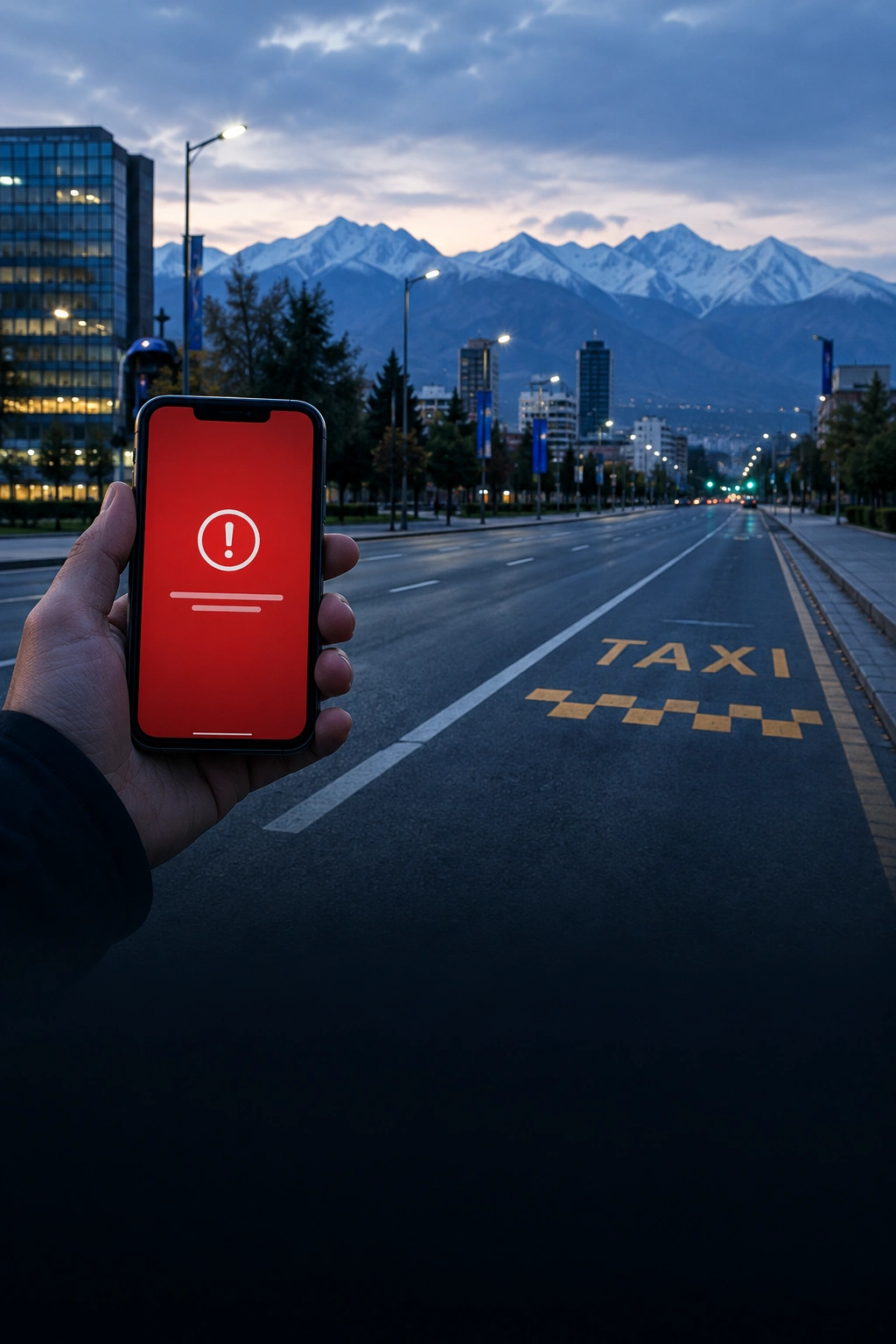
On the morning of October 11, 2026, nobody in Almaty could book a ride on Yandex Go, even though the servers holding Kazakh users' data sat inside Kazakhstan and kept running. The problem lay elsewhere: in four days, drones had damaged three Yandex data centers in Russia. Here is what failed in each country, why local data storage does not mean a locally running service, and what that means for anyone who relies on one big app.
Three sites in four days
According to Kommersant, a roughly 12 MW site in Russia's Ryazan region went down on the night of October 8. A 63 MW facility in Kaluga with more than 3,800 racks was partly knocked out on October 9. A roughly 40 MW site near Vladimir, home to the Galushkin supercomputer, stopped on the night of October 11. Together that is about 115 MW, or around 6% of Russia's 1.8 GW commercial data center market, all at one company.
What failed in Russia
- Money: the Yandex Pay app, transfers and savings withdrawals. Card payments kept working.
- Transport: taxis, car sharing, scooters and live transit on Maps.
- Food and shopping: Eats, Lavka grocery delivery and Market.
- Files: parts of Disk and Yandex 360, partly switched off by Yandex itself to free capacity.
- Home: Alice and smart home routines.
- Other companies on Yandex Cloud: more than ten tenants, including the property portal Cian, per Kommersant.
What failed in Kazakhstan
Digital Business reported that on the morning of October 11 taxi booking, Eats and Lavka were down, scooter and power bank rentals were limited, and drivers and couriers received no orders. By 21:40 taxis were bookable again in every class. Yandex Qazaqstan said computing tasks are spread across servers in several countries, so a failure in one can disable features in another. Kazakhstan's digital ministry said servers with Kazakh users' personal data are in the country and worked normally, but "certain components needed for taxi and delivery services are located outside Kazakhstan".
Data here, computing there
Kazakh law requires data that identifies a person to be stored in the country. A taxi order, though, is more than a database record: it means matching a driver, pricing the trip, routing and notifications. Cloud specialist Nurbek Sadykov of qCloudy told Digital Business that the law does not directly regulate where computation on anonymized data happens. Your profile can live in Almaty while the system deciding which car you get, and at what price, runs in another country.
Full duplication in every country is expensive, so companies rely on several data centers backing each other up. That covers the loss of one site. In October 2026 Yandex Cloud lost two availability zones in a week, and the failure spread the way it does in a power grid during a blackout.
The fare spike
Riders moved to inDrive. Its founder Arsen Tomsky said orders in Kazakhstan nearly tripled within hours compared with a normal Sunday. On inDrive, riders and drivers negotiate fares, so prices climbed. Kazakhstan's competition agency sent inDrive a preventive warning, stressing it was not a finding of wrongdoing; the company cut driver commission to 1% in 19 cities and capped price swings during bargaining.
Other countries
Yandex taxi and delivery failures were also reported in Kyrgyzstan, Uzbekistan, Belarus and Armenia on October 11. Yandex has not published per-country figures.
What comes next
Server maker Fplus called getting large volumes of replacement hardware before year-end a "utopia", with lead times of up to six months, and Russian hosting executives expect cloud prices to rise. After the second attack Yandex added a force majeure clause covering drone attacks to its user agreement.
What to do now
- Keep a copy of important photos and documents outside any single cloud.
- Do not keep all your money in one app; a second card from another bank removes the panic.
- Install and log into a backup taxi and delivery app before you need it.
- If an outage stops a loan payment to another bank, screenshot the errors and contact the lender before the due date.