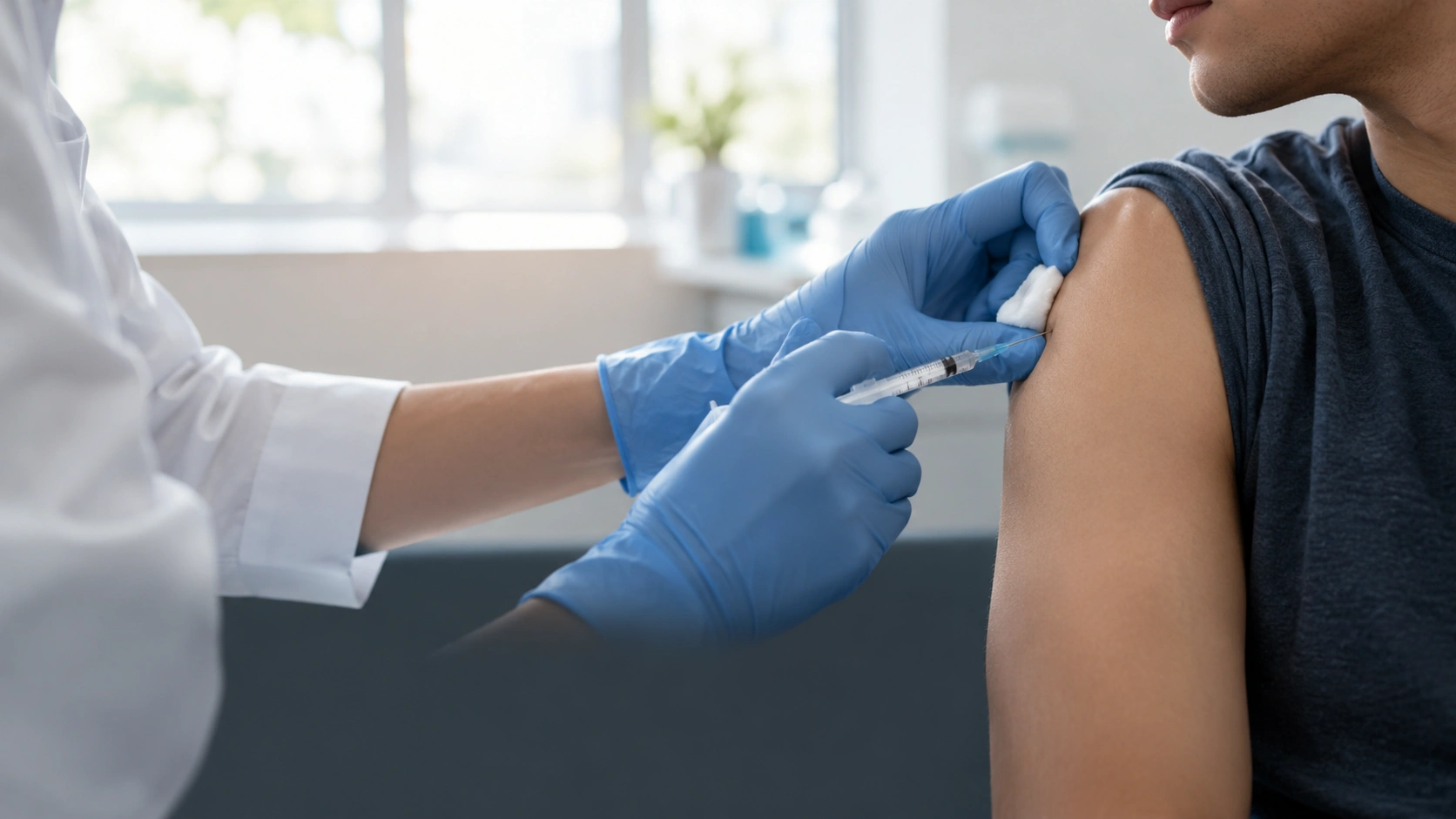
The US flu season has started earlier than usual, and it is almost entirely driven by one virus: H1N1 carrying a new mutation called G155E. By late September 2026, H1N1 made up 96% of positive samples that were subtyped. Early lab tests suggest this year's vaccine still recognizes the virus, though it may protect teens and young adults less well.
What's happening
H1N1 is a type of influenza A, the same one behind the 2009 "swine flu" pandemic. It has since become a regular seasonal flu. Now it carries G155E, a change to one building block of the protein the virus uses to latch onto cells.
What we know as of October 23, 2026:
- United States. CDC data for the week ending September 26 showed about 3.4% of respiratory samples testing positive for flu, roughly 8 times higher than the same week last year. The rise is strongest on the West Coast.
- The mutation is taking over. University of Washington virologist Alex Greninger's lab found G155E in 13 of 17 sequenced H1N1 samples from Seattle hospitals.
- Japan. The mutation was spotted there as early as May 2026. Outbreaks in August and early September closed some schools right after summer break.
- United Kingdom. The share of positive tests is also unusually high for this time of year.
Why the mutation matters most for young people
Scientists call the mechanism "immune imprinting": your immune system is tuned for life to the first flu you caught as a child.
For many teens and young adults, that first flu was the 2009 H1N1. Their antibodies (immune proteins that recognize viruses) focus on exactly the part of the virus where the mutation now sits. Think of a guard who learned to recognize someone by their hat, and now that person shows up in a cap.
A team led by Jesse Bloom at the Fred Hutchinson Cancer Center tested blood from 260 people in Australia and the US against 148 flu viruses. Antibodies recognized some G155E strains less well, especially in teens and young adults. The work is a preprint (not yet reviewed by other scientists), so the findings are preliminary.
Will the flu shot help?
Probably, though not perfectly. The 2026-2027 vaccine is trivalent, targeting H1N1, H3N2 and influenza B. According to experts at Northeastern University, early lab tests suggest the vaccine still recognizes the new variant.
Expected effectiveness is around 30-40% at preventing doctor visits and hospital stays. That sounds modest, but the CDC estimates that in the 2022-2023 season, with similar effectiveness of about 30%, flu shots prevented more than 70,000 hospitalizations and about 3,700 deaths. Real effectiveness data for this season won't arrive until midwinter.
"Now is the time to get vaccinated."
- Samuel Scarpino, professor of public health, Northeastern University, Oct. 22, 2026, Northeastern Global News
What it means elsewhere
An early start doesn't necessarily mean a severe season, researchers warn: the data so far rest on a relatively small number of positive tests.
Still, Northern Hemisphere flu usually peaks between December and February, and the vaccine takes about two weeks to build protection. If the G155E variant spreads the way it has in the US and Japan, getting a shot in November makes more sense than waiting for January headlines.
Editor's view: if you've been putting off your flu shot, this is a good season to stop. That goes double if you're 15 to 30 and assume flu isn't a big deal at your age: early data suggest your protection against the new variant may be weaker. Ask your doctor or pharmacy where you can get vaccinated.